Getting gigabit speeds used to be impossible in most of the UK. But even getting decent internet was a struggle just five years ago. If you’re reading this and still stuck on ADSL, you’re experiencing exactly that struggle—and there’s a reason it feels like you’re living in the internet’s slow lane.
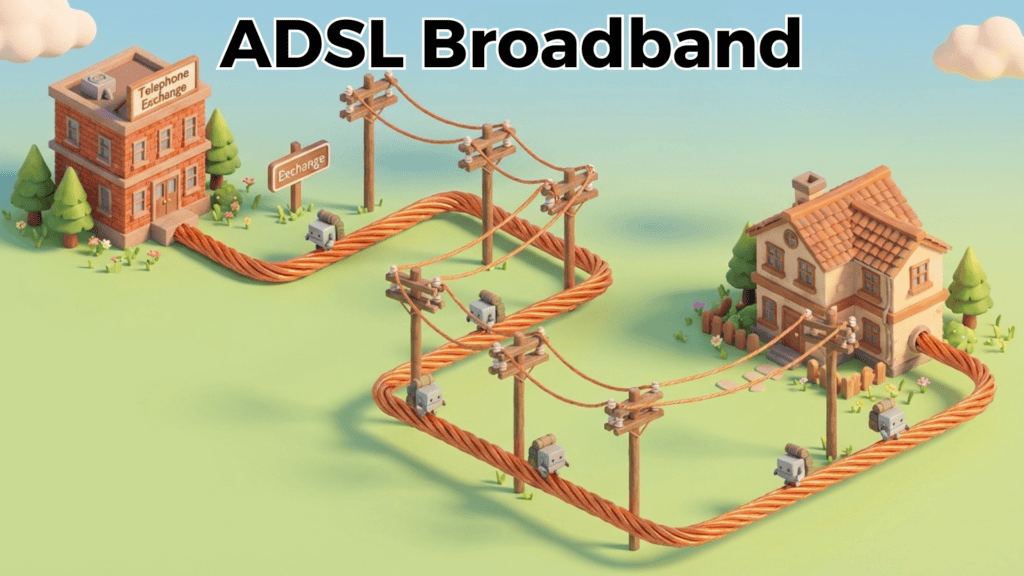
ADSL – Asymmetric Digital Subscriber Line is the oldest broadband technology still in use across the UK. It delivers speeds of just 2–17 Mbps, relying on copper telephone lines that were never designed to handle modern internet demands. In 2026, ADSL is dying. Openreach has stopped accepting new ADSL orders. Providers like Sky and TalkTalk are migrating customers away. And by January 31, 2027, the entire copper network—including ADSL—will be switched off permanently.
This guide explains what ADSL is, why it’s becoming obsolete, what you can actually do at ADSL speeds, and what your realistic upgrade path looks like.
For a complete overview of all broadband technologies, see our Broadband Fundamentals: The Complete UK Guide.
What is ADSL? (Definition & How It Works)
Plain-English Definition
ADSL stands for Asymmetric Digital Subscriber Line. It’s a broadband technology that delivers internet data through standard copper telephone lines—the same lines used for voice calls for decades. The “asymmetric” part means download speeds are much faster than upload speeds, a design choice made in the 1990s when most internet users only needed to receive data, not send it.
In 2026, ADSL is an antiquated technology. It’s being phased out entirely because copper infrastructure is ageing, vulnerable to weather damage, and completely inadequate for modern internet demands (video calls, cloud storage, streaming, remote work).
How ADSL Works (The Technical Breakdown)
Here’s what happens when you connect via ADSL:
- Copper telephone line enters your home from the local exchange (the buildings operated by Openreach that connect neighbourhoods to the wider network)
- Data is split into two pathways: Download (from the internet to you) and upload (from you to the internet)
- Your modem converts the signal from analogue (phone line) to digital (usable by your computer/devices)
- Signal degrades with distance: The further you live from the exchange, the slower your speed. This is why someone 1 km away gets 16 Mbps while someone 5 km away gets 3 Mbps
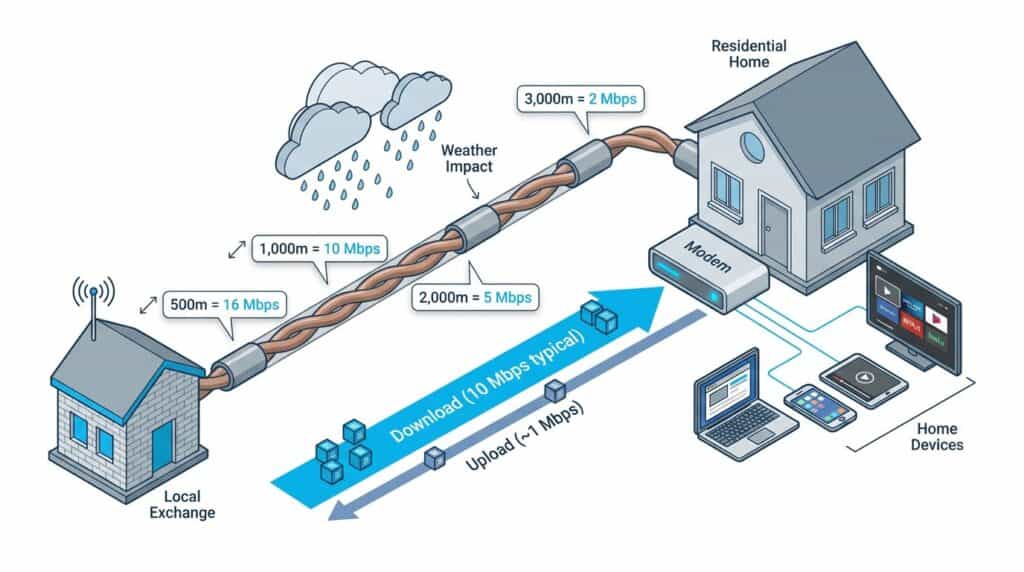
The asymmetrical design is the core problem: Downloads get most of the bandwidth, uploads get almost none. You might get 10 Mbps download but only ~1 Mbps upload. This was fine for browsing websites in 1999. It’s disastrous for 2026.
Key Specifications: What ADSL Actually Delivers
| Metric | Specification | Real-World Context |
|---|---|---|
| Download Speed | 2–17 Mbps (ADSL2+) | Average: 5–10 Mbps in practice |
| Upload Speed | ~1 Mbps | Same speed as downloading a small email attachment |
| Latency (Ping) | 50–100ms+ | Notably higher than modern alternatives |
| Jitter | High variability | Connection feels unstable, especially at distance |
| Availability | Declining; no longer tracked by Ofcom | Roughly 5–10% of UK premises still on ADSL |
| Contract Terms | Month-to-month or 12-month | Prices range £15–25/month (historical rates) |
Why these specs matter:
- 50–100ms latency makes gaming unplayable (you’ll see noticeable lag)
- ~1 Mbps upload means video calls buffer constantly
- High jitter (speed fluctuation) makes even basic browsing feel unreliable
- Distance vulnerability means you can’t predict your actual speed without testing
Why ADSL is Being Phased Out
Three critical reasons ADSL is disappearing:
1. The PSTN Switch-Off (2027 Deadline)
By January 31, 2027, the UK’s Public Switched Telephone Network (PSTN)—the copper infrastructure that carries both voice calls and ADSL—will be permanently shut down. This is a deliberate policy by Ofcom and Openreach to force migration to modern technology. ADSL depends entirely on copper lines. When copper is gone, ADSL is gone. 1
2. Outdated Infrastructure = Reliability Risk
Copper lines are vulnerable to:
- Weather damage (rain, ice, wind damage lines)
- Corrosion and age-related degradation (network average age: 40+ years)
- Electromagnetic interference (nearby electrical equipment causes signal loss)
- No built-in security features (data travels over unencrypted copper)
Modern fibre-optic cables (used in FTTP) are immune to these problems and built with redundancy.2
3. Performance Gap is Unbridgeable
ADSL can deliver a maximum of 24 Mbps. FTTP delivers 150 Mbps–1 Gbps+. No software update, configuration tweak, or hardware upgrade can make ADSL competitive with fibre. Physics doesn’t allow it.
Result: Openreach and ISPs are actively removing ADSL from their systems. New orders stopped in September 2023. Providers are migrating customers to FTTC or FTTP as lines become available.
ADSL Specifications Explained: Real-World Performance
What You Can Actually Do at 5–10 Mbps Download Speed
ADSL speeds vary wildly based on distance from the exchange. A typical ADSL connection delivers 5–10 Mbps download. Here’s what that means in practice:
Basic Activities That Work:
- Email & messaging: Instant (sends/receives in <1 second)
- Web browsing: Loads basic pages in 2–3 seconds; slower on image-heavy sites
- Streaming music (Spotify, Apple Music): Works perfectly; requires only 0.3–0.6 Mbps
- Video calls (Zoom, WhatsApp, Skype): Works for 1:1 calls at 720p; group calls may buffer
- Social media (Facebook, Instagram): Works fine for scrolling; image uploads take 10–30 seconds
- Simple online gaming: Works for turn-based games; real-time games lag noticeably
Activities That Struggle:
- HD video streaming (Netflix 1080p): Requires 5–7 Mbps; works barely with single device 3
- 4K streaming: Impossible; requires 25+ Mbps minimum
- Video uploading: A 1 GB video file takes 2+ hours to upload at 1 Mbps
- Cloud backup: Backing up a 10 GB folder takes 2–3 days
- Multiple simultaneous users: Even two people streaming simultaneously exceeds 10 Mbps
Download time reality check: At 10 Mbps, downloading a 1 GB file takes 14 minutes. A 10 GB game update takes 2+ hours.
Upload Speed: The Real Bottleneck (~1 Mbps)
This is where ADSL becomes genuinely problematic.
ADSL allocates roughly 80% of available bandwidth to downloads, 20% to uploads. With only ~1 Mbps upload:
- Sending a work email with a 5 MB attachment: 40 seconds
- Uploading a 100 MB file to Google Drive: 14+ minutes
- Attending a video call with your camera on: Constant buffering; you appear frozen to others
- Live streaming (YouTube, Twitch): Impossible; requires minimum 5–8 Mbps upload
- Content creation (YouTubers, streamers, freelancers): Completely unviable
For remote workers, the upload limitation is a dealbreaker. You can receive data (download) fine, but sending anything back to clients or colleagues is painfully slow.
Latency and Why It Matters (50–100ms+)
Latency is the delay between sending a request and receiving a response. ADSL typically shows 50–100ms latency.
Comparison:
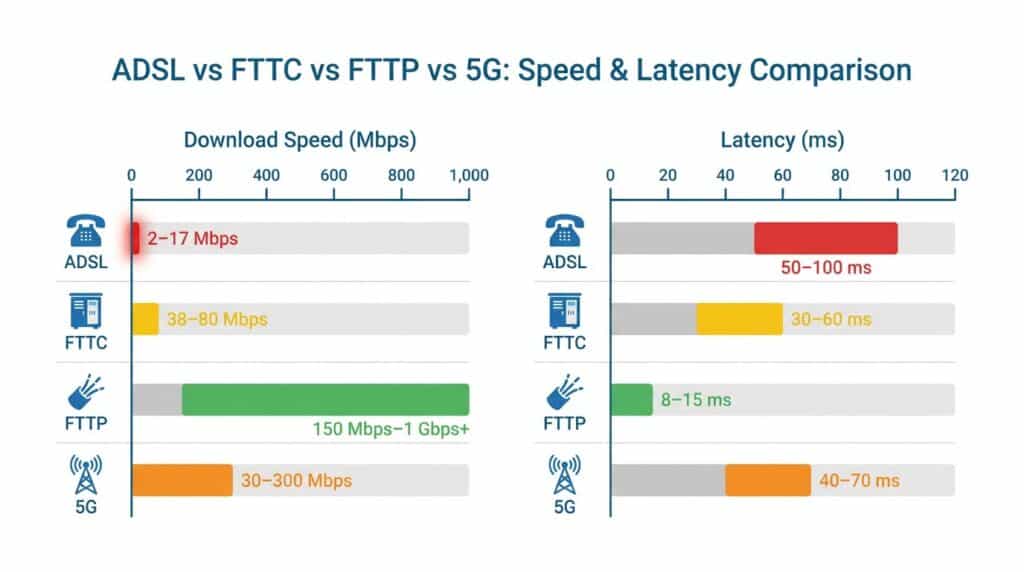
- FTTP: 8–15ms (excellent)
- FTTC: 30–60ms (good)
- ADSL: 50–100ms+ (poor)
- Satellite: 80–150ms (unplayable for gaming)
Why this matters:
For gaming: At 100ms latency, there’s a noticeable delay between your button press and on-screen action. Competitive games (Call of Duty, Valorant) require <20ms latency. ADSL players experience visible lag.
For video calls: At 50ms latency, conversation feels natural. At 100ms+, you get “talk-over” effect (both people talking simultaneously because of delay). ADSL video calls feel choppy.
For real-time trading/financial apps: Unacceptable; traders on stock exchanges use <5ms latency.
Additionally, ADSL suffers from high jitter (variance in latency). Your latency might fluctuate between 50ms and 120ms second-to-second, which feels unstable and unreliable compared to fibre.4
Reliability Issues: Distance Degradation
ADSL speed depends entirely on distance from the telephone exchange:
- 0–500m from exchange: ~16 Mbps (ADSL2+ typical advertised speed)
- 500–1,000m: ~10–12 Mbps
- 1,000–2,000m: ~5–8 Mbps
- 2,000–3,000m: ~2–5 Mbps
- 3,000m+: <2 Mbps (essentially unusable)
This means two neighbours in the same street can have vastly different ADSL experiences. You can’t predict your speed until your line is activated and tested.
Rain fade is another issue: ADSL performance degrades during heavy rain or wet weather because water affects copper signal transmission. You literally get slower internet when it rains.
Contract Terms and Pricing (Where Still Available)
ADSL is no longer actively marketed by major providers. Where it remains available (primarily rural areas with no fibre alternative):
- Sky ADSL: Month-to-month options available; typical pricing £15–20/month
- TalkTalk ADSL: Declining availability; legacy customers still supported
- BT ADSL: Only for existing customers; no new orders
- EE ADSL: Limited availability; being phased out
Note: Pricing is artificially low because ADSL is being discontinued. Providers have no incentive to promote it.
ADSL vs FTTC vs FTTP vs 5G: Complete Comparison
Side-by-Side Technology Comparison Table
| Feature | ADSL | FTTC | FTTP | 5G Home |
|---|---|---|---|---|
| Technology Type | Copper lines only | Fibre to cabinet + copper final mile | Full fibre direct to home | Wireless cellular tower |
| Download Speed Range | 2–17 Mbps | 38–80 Mbps | 150 Mbps–1 Gbps+ | 30–300 Mbps |
| Upload Speed Range | ~1 Mbps | 5–20 Mbps | 100–1,000 Mbps | 10–50 Mbps |
| Latency (Ping) | 50–100ms+ | 30–60ms | 8–15ms | 40–70ms |
| Availability (UK Jan 2026) | ~5–10% (declining) | 99% | 79.5% | ~25% (growing) |
| Infrastructure | Copper telephone lines | Fibre backbone + copper last mile | 100% fibre optic | Wireless towers |
| Speed Affected by Distance? | Yes (major) | Yes (moderate) | No | Sometimes (signal strength) |
| Affected by Weather? | Yes (rain fade) | Slightly | No | Yes (heavy rain) |
| Best For | Legacy users only | Budget streaming households | Gamers, remote workers, content creators | Rural areas, mobility |
| Price Range | £15–20/month | £25–35/month | £35–65+/month | £25–45/month |
| Being Phased Out? | Yes (2027 deadline) | Gradually (5–10 years) | No (expanding) | No (expanding) |
When ADSL Wins (Spoiler: It Doesn’t)
Honestly? There are no scenarios in 2026 where ADSL is the better choice.
The only situation where ADSL is used: Forced choice due to no other availability (rural areas with no FTTC/FTTP/5G coverage).
Even then, 5G Home is becoming available as an alternative in rural areas, and FTTP coverage is expanding rapidly. ADSL’s monopoly on “no-fibre” areas is eroding.
Cost-Benefit Analysis: ADSL vs Alternatives
ADSL Cost-Benefit:
- Monthly cost: £15–20
- Annual cost: £180–240
- Speed: 5–10 Mbps
- Cost per Mbps: £2–4 per Mbps
- Frustration level: High (constant buffering, slow uploads)
FTTC Cost-Benefit:
- Monthly cost: £25–35
- Annual cost: £300–420
- Speed: 40–70 Mbps (typical)
- Cost per Mbps: £0.50–0.88 per Mbps
- Frustration level: Low–moderate (handles HD streaming, multiple users)
FTTP Cost-Benefit:
- Monthly cost: £35–65+
- Annual cost: £420–780+
- Speed: 300–1,000 Mbps (typical tier purchased)
- Cost per Mbps: £0.04–0.22 per Mbps
- Frustration level: Very low (handles everything)
Verdict: FTTC offers 5–8x better value than ADSL. FTTP offers 20–30x better value than ADSL when you factor in speed. The “savings” from cheap ADSL evaporate when you factor in wasted time, frustration, and inability to do anything beyond basic web browsing.
Availability Comparison: Who Can Get What?
- ADSL: Only available in locations where fibre hasn’t been deployed; rapidly shrinking
- FTTC: 99% of UK premises can access; widely available in rural and urban areas
- FTTP: 79.5% of UK premises as of Q3 2025; expanding rapidly; government targets 85% by 2026
- 5G: ~25% of UK as of 2026; growing; best in urban/suburban, less reliable in deep rural
Upgrade path if you’re on ADSL:
- Check your postcode on Openreach’s checker or Ofcom’s availability tool
- If FTTP available: Upgrade to FTTP (best option)
- If only FTTC available: Upgrade to FTTC (good interim solution)
- If nothing available: Consider 5G Home as interim; check rural broadband subsidy schemes for FTTP timeline
Best ADSL Providers: Coverage & Declining Availability
Current Provider Status (January 2026)
The ADSL provider landscape has contracted dramatically. Most major providers have stopped promoting ADSL and are actively migrating customers to fibre alternatives. Here’s the honest breakdown:
Sky ADSL: The Last Active Provider
Current Status: Still actively accepting ADSL orders in areas without fibre alternatives.
Sky Broadband

Highly rated service Great Hardware
✅ Packages offering speeds up to 900 Mbps.
✅ Low latency for competitive gaming
✅ Great customer support with quick response rates.
Coverage: Available across the UK where FTTC/FTTP hasn’t been deployed; primarily rural areas.
Speed Tiers Available:
- Superfast ADSL: Up to 24 Mbps (where ADSL2+ lines qualify)
- Standard ADSL: Up to 17 Mbps (typical)
- Basic ADSL: Variable (distance-dependent)
Pricing: Month-to-month plans available around £15–20/month.
Why Sky? Sky has the largest ADSL customer base due to their acquisition of TalkTalk’s legacy lines. They’re maintaining ADSL support for existing customers and accepting limited new sign-ups in genuinely underserved areas.
Upgrade Path: Sky actively promotes fibre alternatives. When you apply for ADSL on Sky’s website, they first check if FTTC or FTTP is available—and recommend upgrading if possible.
TalkTalk ADSL: Legacy Support Only
Current Status: Still offers ADSL to existing customers; new sign-ups extremely limited.
Coverage: Available but declining; TalkTalk has sold off much of their ADSL customer base to other providers.
Pricing: £15–25/month (legacy rates for existing customers).
Why It’s Declining: TalkTalk invested heavily in FTTP expansion and is deliberately migrating ADSL customers. They no longer aggressively market ADSL new plans.
BT ADSL: Practically Discontinued
Current Status: “Almost no one can get this package anymore” (BT’s own statement).
BT Broadband
Fast Reliable Nationwide Broadband
✅ Guaranteed minimum speeds up to 900 Mbps.
✅ Highly rated BT Smart Hub routers
✅ Great customer support with quick response rates.
Coverage: Only for existing legacy customers; new orders effectively halted.
Why: BT owns the Openreach infrastructure and has been prioritizing FTTC and FTTP rollout. They’re completing the forced migration of ADSL customers by the 2027 copper switch-off deadline.
EE ADSL: Limited & Being Phased Out
Current Status: Offers ADSL at max 17 Mbps but only where fibre isn’t available; new orders rare.
EE Broadband

Powered by BT With Great Hardware
✅ You crave blistering speeds (1.6Gbps is overkill, but future-proof).
✅ Gaming or WFH is non-negotiable (hello, Game Mode!).
✅ You value quick customer support and low complaint rates.
Coverage: Shrinking; primarily legacy customer support.
Bundling: EE packages ADSL with mobile contracts (bundled discounts available).
Note: EE is a Virgin Media-owned brand, and Virgin Media’s strategy is to migrate all ADSL customers to FTTP or 5G Home.
Plusnet ADSL: Deprecated
Current Status: No longer actively marketed; landline service being phased out.5
Coverage: Only for existing customers in no-fibre areas.
Pricing: Discontinued from the standard pricing page; requires direct customer support contact.
Timeline: Plusnet announced landline service shutdown, which indirectly affects ADSL (since ADSL depends on landline infrastructure).
Regional Rural ISPs
In truly remote areas where no major provider offers ADSL, small regional ISPs sometimes still provide it:
Examples:
- B4RN (Broadband for Rural North): Focuses on FTTP deployment but inherited some ADSL legacy customers
- Community Broadband: Focus now on FTTP, not ADSL
- Local authority broadband schemes: Many now skip ADSL and go straight to FTTP
Reality check: Even rural areas are rapidly jumping to FTTP or 5G, so regional ADSL is becoming a rarity.
Why ADSL Availability is Shrinking
Three factors explain the rapid decline:
1. Openreach Copper Switch-Off (2027 Deadline)
Every quarter, ~200,000 ADSL lines are being deactivated as Openreach removes copper infrastructure. By January 31, 2027, all ADSL will be technologically impossible.
2. Stop Sell Policy (September 2023)
Openreach formally stopped accepting new ADSL orders in September 2023. ISPs can still support existing ADSL lines through 2027, but they can’t sign up new customers in most locations.
3. Profitability Issue
ADSL margins are razor-thin. Providers make more money on FTTC and FTTP services. They have zero financial incentive to promote ADSL.
If You’re Currently on ADSL
Your options:
- Check availability immediately on Openreach’s checker (postcode lookup)
- FTTP available? Migrate within 2–3 weeks; order through any FTTP-supporting ISP (Sky, TalkTalk, EE, Plusnet, BT, Hyperoptic, Virgin Media, etc.)
- Only FTTC available? Upgrade to FTTC; it’s 4–8x faster and more reliable
- Nothing available? Check 5G Home (EE, Vodafone, O2); increasingly viable rural alternative
- Rural area with genuine no-options? Apply for government rural broadband grants (some areas still receive FTTP subsidies)
Who Should Choose ADSL? (Use Cases & Personas)
Honest Answer: Almost Nobody in 2026
There is no scenario where ADSL is the smart choice. That said, here’s who might be forced onto it:
Rural Residents with No Alternatives (The Only Legitimate Use Case)
Scenario: You live 10+ km from the nearest telephone exchange. FTTC isn’t available. FTTP won’t arrive until 2027. 5G has no signal in your area.
Can ADSL work? Barely. If you:
- Work locally or offline (not remote work requiring video calls)
- Don’t stream video or download large files
- Use internet primarily for email and basic browsing
- Have only 1–2 household members using internet simultaneously
Can’t work: If you need to upload files, attend video calls, stream HD video, or support multiple users.
Better option? Investigate 5G Home (even in rural areas, coverage is expanding). 5G Home typically delivers 50–100 Mbps and doesn’t depend on copper infrastructure.
Budget-Conscious Users (Poor Trade-Off)
Scenario: You want the cheapest possible broadband.
ADSL costs £15–20/month. FTTC costs £25–35/month. The £10/month difference is offset by:
- Time wasted waiting for pages to load
- Inability to do modern work (video calls, cloud apps, file uploads)
- Frustration with buffering and lag
- Technology being discontinued in 18 months anyway
Better option? Invest the extra £10/month in FTTC now; you’ll save time worth far more than that monthly difference.
Remote Workers (NOT Suitable)
Can ADSL work for remote work? No.
Even basic remote work requires:
- Video calls: ADSL upload speed (~1 Mbps) causes constant freezing on Zoom/Teams
- File uploads: Sending a 500 MB file to your employer takes 7+ minutes
- Cloud software: SaaS apps (Google Workspace, Salesforce, etc.) lag on ADSL
- VPN connections: Unstable over ADSL due to high jitter
Minimum requirement: FTTC (or 5G Home if available). Remote workers need upload speeds of at least 5 Mbps; ADSL fails this bar.
Content Creators & Streamers (Completely Unsuitable)
ADSL is impossible for:
- YouTubers: Uploading a 4K video takes 2+ days on ADSL
- Twitch streamers: Need 5–8 Mbps upload; ADSL provides ~1 Mbps
- Podcast producers: Multi-hour audio files take too long to upload
- Photographers: Cloud backups (Dropbox, Adobe Cloud) are impractical
Minimum requirement: FTTP (500+ Mbps upload) for professional content work.
Gamers (Unplayable)
ADSL latency (50–100ms) + jitter (high variance) makes gaming frustrating:
- Casual gaming: Might work for turn-based games (Chess.com, Solitaire)
- Competitive gaming: Call of Duty, Valorant, Fortnite require <30ms latency; ADSL can’t compete
Better option: FTTC minimum (30–60ms latency is acceptable for most games).
Streaming Households (Struggling)
Want to stream Netflix, YouTube, or BBC iPlayer?
- 1 device HD streaming: ADSL barely works (5–7 Mbps required; ADSL delivers 5–10 Mbps at absolute limit) 6
- 2 simultaneous streams: Impossible on ADSL
- 4K streaming: Completely impossible
Better option: FTTC (40+ Mbps supports 3+ HD streams simultaneously).
Legacy Users (You’re Stuck)
If you’re already on ADSL:
- You’ve gotten used to slow speeds
- You might have a legacy landline package bundled with it
- You haven’t realized alternatives are now available
Action: Check availability. FTTP is now accessible to 79.5% of UK premises. You’re likely eligible to upgrade.
Is ADSL Right for You?
Short answer: No.
In 2026, ADSL is a legacy technology in its final 18 months. It’s being actively phased out by ISPs and technology providers. Even in genuinely remote areas with no fibre access, 5G Home or government rural broadband schemes are becoming viable alternatives.
The only scenario where ADSL makes sense is if:
- You have zero alternatives (no FTTC, FTTP, 5G)
- Your usage is minimal (basic email, light browsing)
- You’re temporary until FTTP arrives in your area
If you’re reading this article and still on ADSL, the action is clear:
- Check your postcode on Openreach.com or Ofcom’s checker
- Assess your options: FTTP > FTTC > 5G Home
- Order your upgrade today (2–3 week wait is normal)
- Don’t wait for 2027: Providers will force migration closer to the copper switch-off deadline, and they’ll have limited capacity to handle everyone simultaneously
The internet experience you deserve—fast, reliable, capable of multiple simultaneous users and modern applications—is now available to 99% of UK premises. ADSL was acceptable in 2005. In 2026, it’s a frustration you can eliminate for less than a cup of coffee per month.
Upgrade. Your remote work calls, streaming, gaming, and sanity will thank you.
Common Questions & Troubleshooting (FAQ)
Is ADSL Being Discontinued?
Yes, definitively. By January 31, 2027, ADSL will cease to exist. The UK government and Ofcom have mandated the copper switch-off. There is no scenario in which ADSL survives beyond 2027.
Providers have been clear: they’re migrating all ADSL customers to fibre/wireless alternatives by that deadline.
Why is ADSL So Slow?
Three reasons:
1. Copper limitations: Copper wires transmit electrical signals that degrade over distance. Fibre uses light pulses, which experience almost no degradation. The physics is against copper.
2. 1990s design: ADSL was engineered for a time when the average internet use was email and static websites. It was never built to handle video streaming, cloud apps, or simultaneous multi-user households.6
3. Infrastructure age: UK telephone lines average 40+ years old. Ageing copper corrodes, becomes vulnerable to weather, and loses signal quality. Newer fibre infrastructure has built-in redundancy and error correction.
Result: Maximum speed on old copper is ~24 Mbps. That’s a physical ceiling, not a marketing limitation.
Can I Upgrade from ADSL?
Yes, almost certainly. As of Q3 2025:
- 79.5% of UK can access FTTP
- 99% of UK can access at least FTTC
- ~25% of UK can access 5G Home
To check:
- Visit Openreach.com and enter your postcode
- OR visit Ofcom’s availability checker
- OR call your current ISP and ask what’s available at your address
Timeline: Most upgrades happen within 2–4 weeks of ordering. Fibre installation is typically faster than ADSL setup.
Cost: Usually no extra charge to switch from ADSL to FTTC or FTTP (your ISP covers most/all installation costs).
Will ADSL Still Work in 2026 and Beyond?
Yes until 2027. ADSL will function as normal through 2026. However:
- Prices won’t improve (no investment in legacy tech)
- Outages are increasingly common (aging infrastructure)
- ISP support is minimal (resources focused on fibre)
- Your provider might proactively migrate you off
Smart move: Upgrade voluntarily before you’re forced to migrate in 2026–2027.
What’s My Best Alternative to ADSL?
Decision tree:
FTTP Available? → Upgrade to FTTP. Best option. Fastest, most reliable, future-proof.
FTTP not available; FTTC available? → Upgrade to FTTC. Good interim solution. 4–8x faster than ADSL. Widely available.
Neither FTTP nor FTTC available? → Check 5G Home (EE, Vodafone, O2). Growing option. No installation required. 50–100+ Mbps typical.
None of the above available? → You’re in a genuinely underserved area. Options:
- Apply for government rural broadband subsidies
- Contact your local council about FTTP deployment timelines
- Consider satellite Starlink as a temporary bridge (high latency but now viable)
How Long Until FTTP Reaches My Area?
UK Government targets:
- 85% of UK by end of 2026
- 99% of UK by end of 2030 (stretched from original 2025 deadline)
Your postcode: Check Openreach’s website for your area’s specific FTTP rollout timeline. Many areas already have dates announced (Q2 2025, Q3 2025, etc.).
Can I Keep My Current Phone Number If I Upgrade?
Yes. FTTC, FTTP, and 5G Home all support landline numbers via VoIP (Voice over IP). Your number transfers when you switch providers (takes 1–2 weeks).7
Note: This is why the copper switch-off is happening. VoIP is more efficient, flexible, and future-proof than traditional PSTN.
What’s the Difference Between ADSL and ADSL2+?
ADSL2+ is a newer variant of ADSL that theoretically delivers up to 24 Mbps (vs standard ADSL at 8 Mbps). However:
- Both are copper-based
- Both are being phased out
- Both suffer from distance degradation
- 95% of UK ADSL lines are ADSL2+, so this distinction is outdated
Don’t worry about it: Whether you have ADSL or ADSL2+, the advice is the same: upgrade to FTTC or FTTP.
Sources Cited:- Tela Technology – Copper Network Switch Off, 2025 – https://www.telatechnology.com/blog/copper-network-switch-off-2025/[↩]
- bOnline – What Are the Risks of Outdated Broadband? – https://www.bonline.com/knowledge-hub/risks-outdated-broadband/[↩]
- Which? – What Broadband Speed Do I Need? – https://www.which.co.uk/reviews/broadband/article/what-broadband-speed-do-i-need-aRxZX0q3jekp[↩]
- Reddit – Why FTTC way less jitter than ADSL? – https://www.reddit.com/r/HomeNetworking/comments/axwno5/why_fttc_way_less_jitter_than_adsl/[↩]
- Data Center Dynamics – Plusnet to shutdown landline services in UK – https://www.datacenterdynamics.com/en/news/plusnet-to-shutdown-landline-services-in-uk/[↩]
- Sonic Internet – What Speeds Can I Expect on ADSL2+/VDSL2 – https://help.sonic.com/hc/en-us/articles/115007031987-What-Speeds-Can-I-Expect-on-ADSL2-VDSL2[↩][↩]
- BT Business – The PSTN and ISDN switch-off: what it means for you – https://business.bt.com/help/article/phone-line-and-services/move-from-traditional-lines-to-the-cloud/the-pstn-and-isdn-switch-off[↩]