Getting gigabit speeds used to feel like a luxury reserved for metropolitan tech hubs. Yet across the UK, FTTP technology—a revolutionary fibre infrastructure that eliminates copper bottlenecks entirely—is becoming the standard for high-performance broadband. As of Q3 2025, over 26.7 million UK premises now have access to FTTP services, representing a fundamental shift in how British households and businesses access the internet. 1
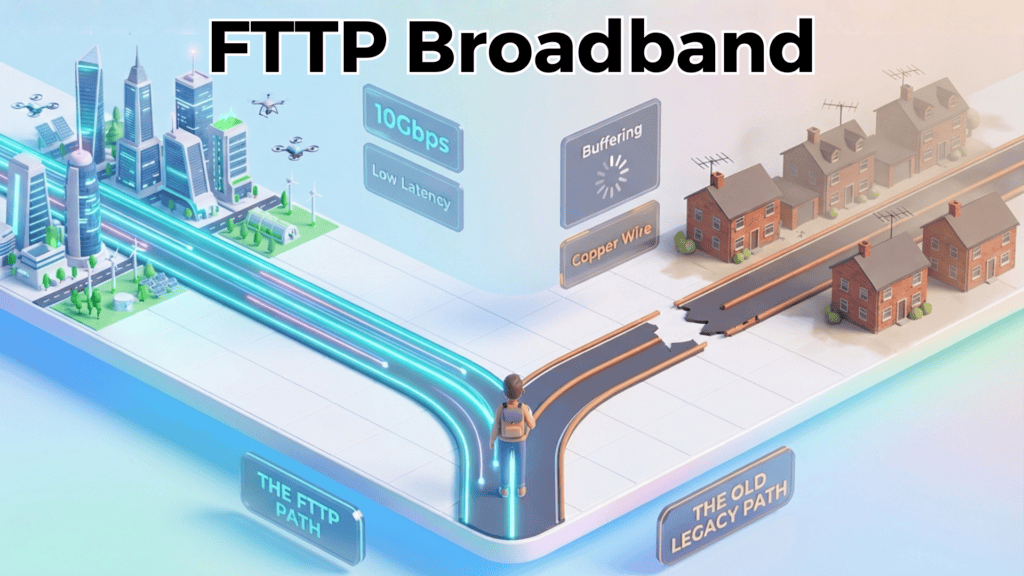
FTTP stands for Fibre To The Premise, a technology that delivers fibre optic cable directly into your home or office, bypassing the copper telephone wires that have constrained download speeds, upload performance, and reliability since the internet’s early days. Unlike its predecessor technologies, FTTP transmits data via light pulses through optical fibre, achieving symmetrical speeds that transform upload performance from a bottleneck into a genuine asset.
This article explains what FTTP technology is, how it works, how its specifications compare to FTTC, Cable, and 5G Broadband alternatives, which providers offer it, and crucially—whether FTTP is the right choice for your use case.
Whether you’re a remote worker frustrated by video call delays, a content creator struggling with upload times, a gamer seeking low latency, or a budget-conscious household evaluating broadband ROI, this guide provides the data-driven answers you need to make an informed decision.
What is FTTP? (Definition & How It Works)
Plain-English Definition
FTTP, or Fibre To The Premise, is a broadband infrastructure in which fibre optic cable runs directly from the Internet Service Provider’s network backbone into your home or business premises, terminating in a small device called an Optical Network Terminal (ONT). From the ONT, you connect your router via either copper wire or fibre—either way, the critical difference from FTTC is that the heavy lifting of data transmission has already occurred through optical fibre.
The term “full fibre” is synonymous with FTTP and emphasises the key advantage: unlike hybrid technologies that switch from fibre to copper midway, FTTP uses fibre for the entire distance from the exchange to your premises.2
For a complete overview of all broadband technologies, see our Broadband Fundamentals: The Complete UK Guide for 2026.
How FTTP Technology Works
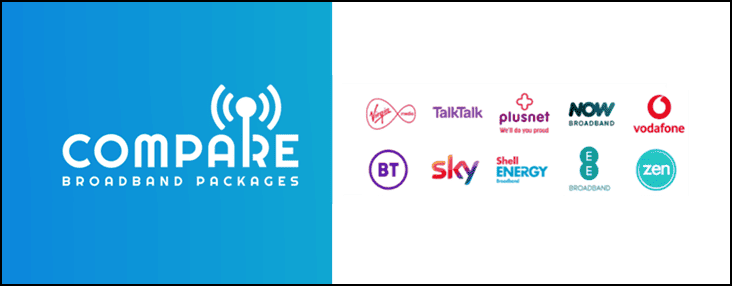
Data travels through FTTP infrastructure as pulses of light—not electrical signals. This is the fundamental technical distinction that drives FTTP’s performance superiority.
Here’s how it works: An ISP’s network contains data encoded as streams of light pulses. These light signals travel through hair-thin strands of glass (fibre optic cable) at the speed of light. Because light doesn’t degrade over distance the way electrical signals in copper wires do, the signal arrives at your premises with minimal signal loss, regardless of whether your home is 100 metres or 2 kilometres from the network hub. Your ONT converts these light pulses back into electrical signals that your router understands.
The critical technical consequence: because the primary transmission path experiences negligible signal degradation, ISPs can offer symmetrical speeds—meaning upload speeds match download speeds. On FTTC networks, which switch to copper for the final connection, the copper portion allocates narrower bandwidth to uploads due to signal degradation over distance; this is why FTTC uploads are typically 1/10th of the download speed. FTTP eliminates this architectural limitation.
FTTP vs Related Technologies
The performance gap between FTTP and alternatives stems from this core infrastructure difference:
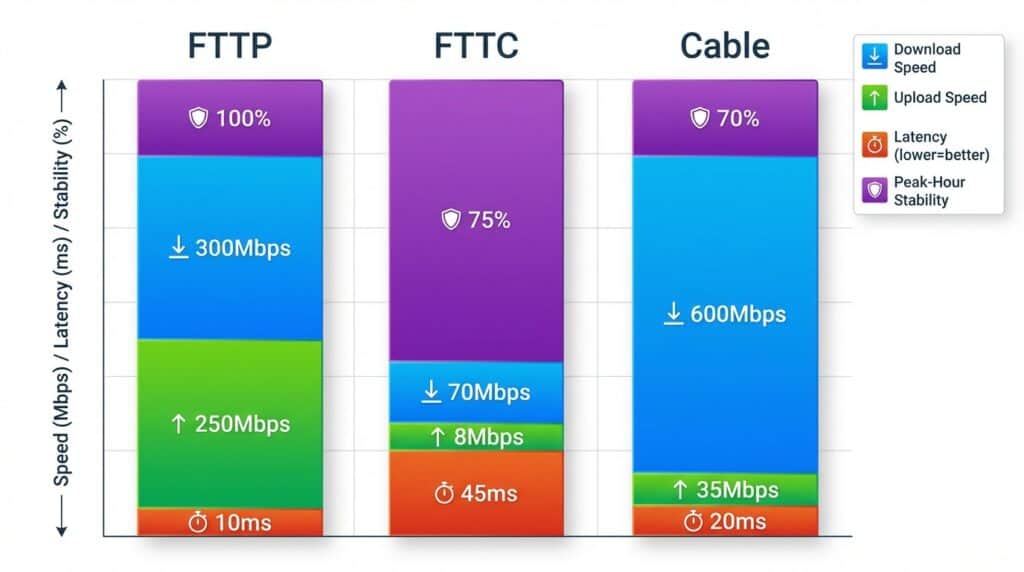
FTTP vs FTTC: FTTC delivers fibre only to a street cabinet (green box), then switches to copper telephone wires for the final connection to your home. This copper “last mile” is the bottleneck. As distance from the cabinet increases, FTTP users receive 30x faster speeds than FTTC users in the same area because FTTP avoids copper degradation entirely. FTTP upload speeds reach 100–1,000 Mbps; FTTC uploads typically max at 5–20 Mbps despite comparable download speeds.
FTTP vs Cable: Virgin Media’s cable network uses hybrid fibre-coax (HFC)—fibre to a street cabinet, then coaxial cable to homes. Cable delivers exceptional download speeds (up to 1,130 Mbps), but uploads remain capped at 35–52 Mbps due to the asymmetric nature of the cable architecture. FTTP offers symmetrical speeds across all tiers, making cable unsuitable for upload-intensive work.
FTTP vs 5G Broadband: 5G home broadband delivers 30–300 Mbps download speeds via wireless antenna; upload speeds range 10–50 Mbps. Latency averages 40–70ms, which is acceptable for most tasks but unacceptable for competitive gaming (8–15ms FTTP vs 40–70ms 5G). 5G is weather-dependent and experiences congestion during peak hours; FTTP is stable 24/7.
FTTP vs Satellite Broadband: Starlink and Viasat deliver broadband via satellite orbiting Earth. Modern LEO (low-earth-orbit) satellites achieve latency around 20–50ms and download speeds of 50–100 Mbps, making them viable for rural areas where no terrestrial alternative exists. However, they remain weather-dependent and unsuitable as a permanent solution for urban/suburban users where terrestrial fibre is available.
Key Specifications
As of Q3 2025, FTTP’s real-world performance in the UK is quantified as follows:
- Speed Range: 145 Mbps to 2,500+ Mbps (depending on plan tier purchased)
- Upload Range: 100–1,000+ Mbps (symmetrical or near-symmetrical)
- Latency: 8–15 milliseconds average
- Jitter: <3 milliseconds (minimal variance)
- Speed Stability: Consistent performance during peak evening hours; no throttling or degradation
- Availability: 79.5% of UK premises (Q3 2025), growing at ~2.3% quarterly
FTTP Specifications Explained
Download Speeds in Real-World Context
FTTP download speeds range from 145 Mbps entry-level to 2,500+ Mbps on ultra-premium plans. Understanding what these numbers mean in lived experience is critical to determining whether a particular speed tier meets your actual requirements.
A 145 Mbps connection downloads a 1GB file in ~55 seconds. The same connection streams Netflix 4K, supports two simultaneous video calls, and handles routine browsing with zero perceptible lag. For a single-person household prioritizing streaming and light work, 145 Mbps suffices.
A 300 Mbps connection handles 3–4 simultaneous HD streams, remote work with video conferencing, and gaming without congestion. This tier suits households with 3–4 people sharing bandwidth across multiple devices.
A 900 Mbps connection delivers essentially unlimited capacity for household use: 4K streams on multiple devices, heavy file downloads, simultaneous gaming and video conferencing, and cloud backups all occurring in parallel without perceptible impact. Ultra-gigabit users benefit primarily through reduced wait times on large downloads and uploads, not through qualitative performance improvement.
One critical point: FTTP’s speed stability means these performance levels persist during peak evening hours (6–10 PM) when network congestion typically degrades other technologies. An FTTP user watching 4K video at 8 PM experiences the same speed as at 2 PM. A cable user on Virgin Media typically sees 20–35% speed degradation during peak hours.
Upload Speeds & Symmetrical Benefits
FTTP’s defining characteristic is symmetrical or near-symmetrical upload speeds—a capability that fundamentally differentiates FTTP from all competing technologies.
FTTC delivers 65 Mbps download with 5–8 Mbps upload. The 50+ Mbps gap creates a genuine bottleneck for upload-intensive tasks. Uploading a 50GB video file requires 8+ hours on FTTC; the same file uploads in <30 minutes on FTTP with 100+ Mbps upload. This isn’t merely faster—it’s the difference between “practically possible” and “effectively impossible” for many creative professionals.
Symmetrical upload speed transforms professional workflow. A video editor working from home on FTTP can:
- Upload video files to cloud storage (100+ Mbps) while simultaneously attending video calls (5–8 Mbps upload) and streaming reference material (8+ Mbps download)
- Back up large project files to redundant cloud locations for disaster recovery
- Collaborate on live file-sharing platforms without bottlenecking other household users
On FTTC, any one of these tasks would max out available upload bandwidth, causing video calls to stutter and other cloud-dependent work to pause.
Latency & Reliability
Latency measures the time data takes to travel from your device to a remote server and back—expressed in milliseconds (ms). For real-time applications like gaming, video calls, and trading, latency is often more important than raw speed.
FTTP achieves 8–15ms latency, making it the only consumer broadband technology suitable for competitive online gaming. A 15ms latency provides sufficient responsiveness for professional esports; 30+ ms latency (typical on FTTC) introduces noticeable lag that handicaps competitive performance.
For video conferencing, FTTP’s low latency eliminates perceived delay—your conversation partner hears your response in real time. On 50+ ms connections (FTTC, 5G, or satellite), conversation develops an artificial delay that makes dialogue feel awkward.
Jitter—variance in latency—matters as much as latency itself. FTTP’s <3ms jitter ensures consistent responsiveness; 5–10ms jitter on cable or 10–25ms jitter on 5G creates perceptible stuttering in real-time applications.
Contract Terms & Real Pricing Ranges
As of January 2026, FTTP pricing varies by provider and speed tier:
Entry-Level (145–150 Mbps):
- Hyperoptic: £20–£30/month
- Community Fibre: £20–£25/month
- BT Openreach: £35–£45/month
- Plusnet: £25–£35/month
Mid-Tier (300–300 Mbps):
- Hyperoptic: £35–£45/month
- Community Fibre: £30–£35/month
- BT Openreach: £45–£55/month
- Plusnet: £35–£45/month
Premium (900+ Mbps):
- Hyperoptic: £60–£100/month
- Community Fibre: £40–£61/month (up to 5Gbps)
- BT Openreach: £60–£75/month
- Virgin Media Gig1: £60–£80/month (cable alternative)
Installation Costs: Most providers offer free installation on 12+ month contracts; standalone installation fees range £29.99–£60. Some providers waive installation for month-to-month or rolling contracts.
Contract Terms: Standard 12–24 month contracts; select providers (Hyperoptic, month-to-month options) offer flexible rolling contracts with no lock-in period.
FTTP vs FTTC vs Cable: Head-to-Head Comparison
| Metric | FTTP | FTTC | Cable (DOCSIS 3.1) |
|---|---|---|---|
| Download Speed Range | 145–2,500+ Mbps | 38–80 Mbps | 60–1,130 Mbps |
| Upload Speed Range | 100–1,000+ Mbps (symmetrical) | 5–20 Mbps (asymmetrical) | 35–52 Mbps (asymmetrical) |
| Typical Latency | 8–15 ms | 30–60 ms | 15–25 ms (off-peak); 20–40 ms (peak) |
| Jitter | <3 ms | 5–15 ms | 5–10 ms typical; 15–30 ms peak |
| Speed Stability (Peak Hours) | Consistent; no degradation | Degrades 15–30% | Degrades 20–35% on congested segments |
| UK Availability | 79.5% (Q3 2025), growing | 99% (declining) | ~50–60% (Virgin Media footprint) |
| Price (Entry-Level) | £20–£35/month | £25–£35/month | £25–£35/month |
| Price (Premium) | £60–£100/month | Not applicable (max speed limits) | £60–£80/month |
| Best For | Remote workers, gamers, content creators, future-proofing | Budget-conscious, light internet use | Urban areas with cable coverage, streaming-first households |
| Key Weakness | Limited availability outside metro areas | Upload bottleneck (5–8 Mbps), peak-hour degradation | Asymmetrical uploads, shared cable congestion, higher than FTTP latency |
When FTTP Wins
FTTP decisively outperforms alternatives in three critical areas:
Upload Performance: A content creator uploading 50GB weekly faces 8+ hours of upload time on FTTC but <30 minutes on FTTP—a 16x improvement that converts “impractical” to “routine.”
Latency Advantage: FTTP’s 8–15ms latency enables competitive gaming and real-time trading applications unsuitable on 30–60ms FTTC or 40–70ms 5G connections.
Peak-Hour Stability: While cable networks degrade 20–35% during peak evening hours, FTTP maintains advertised speeds 24/7, making it the only technology delivering consistent performance for household simultaneous usage.
When FTTC or Cable is Better
FTTC remains relevant for budget-conscious households with basic internet needs. Email, web browsing, SD streaming, and casual video calls function perfectly on 65 Mbps FTTC at £25–£35/month. A single-person household prioritizing cost over performance rationally chooses FTTC.
Cable (Virgin Media) excels for streaming-first households in available areas. Download speeds up to 1,130 Mbps support 4K on multiple devices simultaneously. While cable’s asymmetrical upload (35–52 Mbps) suits general users, it underperforms FTTP for upload-intensive work.
FTTC also currently boasts wider availability (99% vs FTTP’s 79.5%), making it the only option in some rural areas pending government-funded FTTP rollout.
Cost-Benefit Analysis by Persona
Content Creators: FTTP premium (£50–£100/month for 100+ Mbps upload) is justified when upload efficiency gains translate to professional productivity. A creator earning £50/hour recouping 7+ hours weekly (through upload speed difference on regular workflows) recovers FTTP’s monthly premium in efficiency gains alone.
Remote Workers: FTTP entry-level (£25–£35/month for 145 Mbps, 100+ Mbps upload) justifies premium over FTTC (£25–£35/month for 65 Mbps, 5–8 Mbps upload) for video conferencing reliability and simultaneous cloud work. The symmetrical upload eliminates call stuttering and file-upload delays—productivity benefits that exceed cost difference.
Budget Households: FTTC at £25–£35/month remains rational if download speeds suffice and upload is non-critical. A 4-person household watching streaming + light browsing + one work-from-home video call can manage on FTTC; simultaneous streaming and video conferencing require FTTP.
Best FTTP Providers & Coverage
Provider List by Region and Infrastructure
As of Q3 2025, FTTP coverage across the UK is delivered by five dominant infrastructure operators, complemented by numerous smaller regional providers. Understanding which provider serves your area is essential because infrastructure quality directly impacts real-world performance.
BT Openreach – The Incumbent Giant
BT Openreach operates the UK’s largest FTTP footprint: 19.7 million premises passed (58.7% of UK), growing at ~1 million premises quarterly. Openreach is the systematic successor to British Telecom’s copper network, having transitioned infrastructure from ADSL to FTTC to FTTP over the past decade. Coverage is nationwide, with particular strength in Northern Ireland (Belfast at 96.5% FTTP penetration) and strong positions across England, Scotland, and Wales.
Openreach FTTP is available through multiple ISP brands—BT directly, Plusnet, EE, Sky, TalkTalk—making it the de facto default FTTP standard in most UK postcodes. When availability checkers show FTTP available at a rural address, it’s typically Openreach infrastructure.
Speed Tiers Available (Openreach FTTP):
- 145 Mbps: £35–£45/month (BT branded)
- 300 Mbps: £45–£55/month
- 900 Mbps: £60–£75/month; includes symmetrical 110 Mbps upload
Real-world performance consistently matches advertised speeds: 900 Mbps plans achieve 850–900 Mbps download, 110+ Mbps upload, with latency 8–15ms and minimal peak-hour degradation.
BT Broadband
Fast Reliable Nationwide Broadband
✅ Guaranteed minimum speeds up to 900 Mbps.
✅ Highly rated BT Smart Hub routers
✅ Great customer support with quick response rates.
Hyperoptic – Pure Fibre Premium Operator
Hyperoptic, a London-founded venture-backed firm, operates a specialist pure-fibre network focused exclusively on FTTP deployment in urban and dense suburban areas. As of Q3 2025, Hyperoptic passes approximately 1.3 million premises, concentrated in London, Manchester, Birmingham, Bristol, and selective suburban expansion. Hyperoptic distinguishes itself through symmetrical speeds as standard—every plan tier delivers matching upload/download.
Coverage is limited geographically but universal in available areas: if Hyperoptic serves your postcode, 100% of connected households have identical gigabit-capable infrastructure. This is strategically different from Openreach, where coverage can be patchy within postcodes.
Speed Tiers Available (Hyperoptic):
- 150 Mbps symmetrical: £20–£30/month
- 300 Mbps symmetrical: £35–£45/month
- 900 Mbps symmetrical: £60–£100/month; true 900 Mbps upload
Customer satisfaction consistently ranks highest among FTTP providers: 85%+ (vs BT’s 83%, Virgin Media’s 67–75%). Primary appeal: symmetrical upload speeds eliminate professional bottlenecks at entry-level pricing. 3

Community Fibre – London Urban Specialist
Community Fibre operates the UK’s densest full-fibre network: 1.5 million premises in London and select south-east areas, with investment of ~£1 billion in proprietary infrastructure. Unlike Openreach (multi-technology incumbent) or Hyperoptic (expansion-focused), Community Fibre is a mature urban operator with settled network footprint concentrated on London’s 32 boroughs.
Community Fibre is significant for price-performance ratio: symmetrical 150 Mbps available at £20–£25/month (entry-level pricing with symmetrical uploads typically found only at premium tiers elsewhere).
Speed Tiers Available (Community Fibre):
- 150 Mbps symmetrical: £20–£25/month
- 1 Gbps symmetrical: £30–£40/month (actual 920 Mbps sustained)
- 5 Gbps: £40–£61/month (available select locations)
All packages include free installation, WiFi 6 mesh router (Linksys Velop), and 12–24 month contracts. Black Friday 2025 promotion: 6 months free service on all packages.
Gigaclear – Rural Specialist
Gigaclear is the only major FTTP operator focused explicitly on rural and semi-rural deployment. As of Q3 2025, Gigaclear passes 612,200 premises in selective English, Welsh, and Scottish rural areas, often with government funding support through initiatives like Project Gigabit. Where Openreach covers density, Gigaclear covers gaps: areas awaiting commercial FTTP investment where government-subsidised deployment becomes viable.
Coverage is highly fragmented—available in specific postcodes within target regions rather than nationally. Availability checker tools are essential before proceeding.
Speed Tiers Available (Gigaclear):
- 50–150 Mbps: £20–£30/month
- 300 Mbps: £35–£45/month
- Contracts: 12–24 months typical
Performance on Gigaclear’s infrastructure matches other FTTP operators: consistent speeds, low latency, symmetrical uploads at higher tiers.
Virgin Media (Cable Alternative – DOCSIS, not FTTP)
Virgin Media, while not FTTP, deserves inclusion as the primary alternative for gigabit speeds in available areas. Virgin Media operates Hybrid Fibre-Coax (HFC) cable infrastructure passing 18.4 million UK premises (~60% coverage). Cable achieves up to 1,130 Mbps download, but upload speeds cap at 35–52 Mbps—a critical asymmetry unsuitable for upload-intensive users.
Virgin Media relevance: for households in cable footprints without FTTP access, Virgin Media Gig1 (£60–£80/month) delivers exceptional download speed but inadequate upload performance for professionals.
Virgin Media Broadband

Great Speed and Reliability
✅ You crave speed and reliability for streaming/gaming.
✅ Bundling TV/mobile saves you money (especially with Volt).
✅ Future-proofing matters (Gig1/Gig2).
How to Check FTTP Availability
Determining whether FTTP is available at your specific address requires postcode lookup via multiple channels:
Ofcom’s “Checker” Aggregators: Use Ofcom’s official broadband checker (Ofcom.org.uk) or third-party aggregators (Uswitch, MoneySuperMarket) to query your postcode across all UK providers. The tools return real-world availability, not theoretical coverage.
Provider-Specific Checkers: Individual ISPs maintain postcode checkers on their websites:
- BT/Openreach checker (bt.com)
- Hyperoptic checker (hyperoptic.com)
- Community Fibre checker (communityfibre.co.uk)
- Gigaclear checker (gigaclear.com)
Key Data Points from Checks:
- Ready for Service (RFS): The address is currently connected and orders accepted immediately.
- Under Construction: Infrastructure is being deployed; orders may be pre-ordered with estimated activation date.
- Not Planned: No FTTP commitment; address awaits government funding or commercial rollout decisions.
If your postcode shows “no FTTP availability,” verify whether FTTC, cable, or 5G are available. Government Project Gigabit aims to expand FTTP to underserved areas through 2027.
Who Should Choose FTTP? (Use Cases)
Remote Workers
Why FTTP: Remote work has transformed upload speed from optional luxury to essential utility. Video conferencing, cloud file storage, and collaborative document editing all depend on reliable upload bandwidth. FTTP’s 100+ Mbps upload enables simultaneous video calls, file uploads, and screen-sharing without perceptible lag or stuttering.
On FTTC (5–8 Mbps upload), a single 1080p video call with screen-sharing consumes 8–10 Mbps of available 8 Mbps total upload, leaving zero bandwidth for simultaneous cloud saves or background file uploads. Work pauses.
On FTTP (100+ Mbps upload), video calls consume ~5 Mbps while background uploads continue at 50+ Mbps. Multiple video calls occur in parallel without interference.
Verdict: FTTP entry-level (£25–£35/month for 145 Mbps, 100+ Mbps upload) is justified over FTTC for any household with more than one simultaneous remote worker or frequent high-bandwidth cloud collaboration.
Gamers & Esports Competitors
Why FTTP: Competitive multiplayer gaming prioritizes latency above all other metrics. FTTP’s 8–15ms latency provides the responsiveness necessary for professional esports; FTTC’s 30–60ms latency introduces noticeable lag that handicaps performance.
Additionally, voice chat over Discord or in-game comms depends on upload reliability. FTTP’s abundant upload bandwidth ensures voice quality while simultaneous gameplay occurs—a capability unavailable on FTTC’s constrained 5–8 Mbps upload.
Jitter (latency variance) matters equally: FTTP’s <3ms jitter ensures consistent responsiveness; FTTC’s 5–15ms jitter creates intermittent lag spikes that disrupt competitive play.
Verdict: Competitive gamers (ranked play, tournaments) mandate FTTP. Casual gamers may tolerate FTTC if latency/jitter remain within tolerances, but FTTP’s advantage is quantifiable and significant.
Content Creators (Video Production & Live Streaming)
Why FTTP: Content creators face the most extreme upload bottleneck. Uploading a 50GB video file to YouTube takes 8+ hours on FTTC (5–8 Mbps upload) but <30 minutes on FTTP (100+ Mbps upload). For creators publishing daily or multiple times weekly, this difference translates to 7–14 hours weekly of reclaimed productivity.
Live streaming introduces additional demands: streaming to Twitch or YouTube requires stable 10–15+ Mbps upload for HD quality while simultaneously monitoring chat, managing graphics overlays, and running OBS Studio—all tasks competing for available bandwidth. FTTC cannot sustain this load; FTTP handles it effortlessly.
Cloud backup, another critical creator task, exhibits similar bottleneck. A 2TB daily backup takes 2–3 weeks on FTTC but <3 days on FTTP.
Verdict: Any creator publishing video content more than once weekly justifies FTTP’s premium cost through productivity gains alone. Content creators are FTTP’s strongest use case.
Rural Residents
Why FTTP: Rural areas have historically suffered worst broadband inequality. Many premises remain on ADSL (2–10 Mbps) or face years-long waitlists for FTTC/FTTP deployment.
Government’s Project Gigabit initiative targets these underserved premises, prioritizing FTTP rollout to areas without commercial deployment viability. As of 2026, Project Gigabit has expanded FTTP to ~6.5 million additional premises beyond commercial networks. Eligible premises receive up to £4,500 deployment vouchers.
For rural residents with no current FTTP availability, interim options include 5G home broadband (if coverage available: 80–150 Mbps) or satellite (Starlink: 50–80 Mbps). These are functional interim solutions until FTTP deployment completes.
Verdict: Rural residents should check Project Gigabit eligibility (projectgigabit.org.uk). Where available, FTTP represents transformational upgrade from ADSL. Where unavailable, 5G or satellite remain viable alternatives.
Small Business Users
Why FTTP: Businesses depend on broadband availability and performance guarantees that exceed consumer-grade reliability. FTTP’s symmetrical upload speeds (100+ Mbps) eliminate bottlenecks in cloud-dependent workflows: cloud accounting, video conferencing, file backup, and document collaboration all function without friction.
Consumer FTTP lacks formal SLAs (Service Level Agreements) and priority support; business-grade FTTP packages include uptime guarantees (99.5%+), dedicated support lines, and quicker fault resolution.
Cost-benefit varies by business type:
- SaaS/Digital Agencies: High-bandwidth video conferencing, large file transfers, and cloud-dependent workflows justify premium business FTTP pricing (£80–£200+/month).
- Retail/Hospitality: Customer-facing WiFi and payment systems benefit from FTTP but don’t require premium business SLA; consumer FTTP suffices.
- Legal/Accounting: Cloud document storage and video client calls are standard; FTTP’s reliability is non-negotiable.
Verdict: Small businesses should evaluate whether broadband is mission-critical. If yes, business FTTP with SLA is justified. If supplementary, consumer FTTP suffices.
Budget-Conscious Households
Why FTTP May Disappoint: FTTP costs 15–30% more than FTTC at entry-level pricing. A household using broadband for light browsing, email, streaming, and casual video calls may find FTTC’s 65 Mbps adequate for £25–£35/month, making FTTP’s £25–£35/month for 145 Mbps a difficult premium to justify.
However, cost-benefit shifts favourably toward FTTP when considering household size and future-proofing:
- Single-person or light-usage households: FTTC remains rational choice
- Multi-person households (3+): Simultaneous streaming + work video calls + gaming/browsing = FTTP’s improved stability justifies premium
- 5+ year residence duration: FTTP’s future-proof architecture suits long-term households; FTTC approaching end-of-life status
Verdict: Budget households should calculate actual usage patterns. If download speeds of 50+ Mbps and upload speeds of 5+ Mbps suffice, FTTC remains economical. If household includes simultaneous users or upload-intensive tasks, FTTP’s premium is justified by stability and future-proofing benefits.
Conclusion: Is FTTP Right for You?
FTTP represents the current pinnacle of residential broadband technology in the UK. Its symmetrical speeds, low latency, and future-proof infrastructure solve problems that FTTC and cable struggle with: upload bottlenecks, peak-hour degradation, and architectural limitations.
However, FTTP’s value depends entirely on your usage patterns:
FTTP is Essential if:
- You work remotely and require stable video conferencing
- You create or upload video content regularly
- You play competitive online games
- You live in an area with multiple FTTP providers (price competition)
- You plan to remain at your address 5+ years (future-proofing)
FTTC Remains Adequate if:
- Your household uses broadband for light browsing, email, and streaming
- You have no upload-intensive workflows
- Your budget is constrained and FTTP’s premium feels unjustified
- You live in an area where FTTP isn’t available (yet)
Cable is Preferable if:
- You prioritize download speed above all else
- Your usage is streaming-first and you rarely upload
- Cable cost is significantly lower than FTTP in your area
- You accept peak-hour speed degradation in exchange for lower price
To determine whether FTTP is right for you:
- Check Availability: Use Ofcom.org.uk or provider checkers to determine whether FTTP is available at your address
- Assess Upload Needs: Calculate your weekly upload requirements (video files, cloud backup, video calls). If <5 Mbps average, FTTC suffices. If >10 Mbps, FTTP becomes valuable
- Compare Pricing: Calculate monthly cost difference between FTTP and available alternatives. Multiply by 24 months (typical contract). Does the productivity/experience gain justify the cost?
- Test Before Committing: If possible, test a trial period (month-to-month contract) before committing to 12–24 month terms
Final Recommendation: For households with remote workers, content creators, gamers, or multiple simultaneous users, FTTP’s premium cost is justified through genuine productivity and experience improvements. For light-usage households in budget-constrained situations, FTTC remains rational. For streaming-first households, cable’s download leadership may outweigh FTTP’s upload advantage.
Whichever technology you choose, ensure your ISP’s customer service and support quality meet your standards—speed matters little if connection reliability suffers.
Common Questions (FAQ)& Troubleshooting
Is FTTP Really Faster Than FTTC?
Yes, objectively and dramatically. FTTP download speeds range 145–2,500+ Mbps; FTTC maxes at 74–80 Mbps. More importantly, FTTP upload speeds (100–1,000+ Mbps symmetrical) exceed FTTC upload speeds (5–8 Mbps asymmetrical) by 12–200x depending on the tier. The gap isn’t marginal—it’s structural. FTTP eliminates copper’s physical limitations; FTTC is inherently capped by copper’s signal degradation over distance.
The real-world difference: a 50GB file uploads in <30 minutes on FTTP but 8+ hours on FTTC. A 4K video streams smoothly on FTTP during peak hours but stutters on FTTC when other household members browse.
Can I Get Gigabit Speeds on All FTTP Plans?
No. FTTP infrastructure is gigabit-capable, but ISPs sell tiered plans from 145 Mbps entry-level to 2,500+ Mbps premium. Entry-level FTTP (145 Mbps) is slower than gigabit packages, but it delivers speeds impossible on FTTC and with superior upload characteristics.
However, most FTTP providers now offer 900 Mbps “near-gigabit” tiers at £50–£75/month, making true gigabit speeds affordable for mass market.
Why Is My FTTP Slower Than Advertised?
Several factors can reduce real-world speed below advertised maximums:
WiFi Degradation: Advertised speeds assume wired Ethernet connection. WiFi can reduce speeds 20–50% depending on signal strength, interference, and router quality. Solution: use wired Ethernet for speed testing and critical tasks.
Peak-Hour Congestion (Rare on FTTP): While uncommon, oversized networks with many simultaneous users can experience brief congestion. This is rare on FTTP (architecture designed for stability) but common on cable networks.
Router Limitations: Older routers may bottleneck gigabit connections. Modern mesh routers (WiFi 6) fully support FTTP speeds; routers older than 5 years may underperform.
ISP Throttling: Legitimate ISPs don’t throttle FTTP speeds. If speeds are consistently 20%+ below contracted level, contact your ISP for technical investigation.
Typical Rule: Expect 90–100% of advertised speeds on wired Ethernet during off-peak, 85–95% during peak hours on FTTP (vs 70–85% on cable).
Is FTTP Available in My Area?
Use postcode checkers at Ofcom.org.uk, BT.com, Hyperoptic.com, or Community Fibre’s checker. These provide real-time RFS (Ready for Service) availability. If FTTP is unavailable, check Project Gigabit (projectgigabit.org.uk) eligibility for government-funded rollout timelines.
How Long Does FTTP Installation Take?
Standard FTTP installation requires 7–14 working days from order to activation. Installation involves:
- Survey (Day 1–2): Engineer confirms build feasibility and ONT placement location
- Fibre Laying (Day 3–10): Fibre cable run from street to premises (underground or overhead, depending on location)
- ONT Installation (Day 11–12): Optical Network Terminal fitted and configured
- Router Setup & Testing (Day 13–14): Final connection, WiFi configuration, speed verification
Some providers offer self-install options (2–5 days) where customers complete final steps with technician guidance.
Do I Need a Special Router for FTTP?
No. Any modern WiFi 6 router (purchased or ISP-provided) works with FTTP. However, gigabit-tier FTTP (900 Mbps+) benefits from WiFi 6 capable routers; WiFi 5 or older routers may bottleneck wireless performance.
Most FTTP providers include quality routers: Hyperoptic and Community Fibre supply Linksys Velop mesh routers; BT includes Smart Hub routers. These are appropriate for FTTP speeds.
Is FTTP Worth the Cost vs Cable?
Cost-benefit depends on your usage:
Choose FTTP if:
- You upload files regularly (content creators, cloud workers)
- You require consistent peak-hour performance
- You value future-proofing (FTTP infrastructure supports speed upgrades indefinitely)
- You live in a single-provider area where FTTP is the only gigabit option
Choose Cable if:
- You prioritize download speed above all else (cable’s 1,130 Mbps download is fastest available to consumers)
- Your usage is streaming-first and upload-secondary
- Cable cost is significantly lower in your area (£10–15/month savings compounds over years)
- You accept peak-hour speed degradation
For professional users and content creators, FTTP’s symmetrical upload justifies premium cost. For streaming-first households, cable’s download advantage and lower cost may outweigh FTTP’s upload benefits.
Common Myths Debunked
Myth: “FTTP speeds are always 2.5 Gbps”
Reality: FTTP infrastructure is 2.5 Gbps capable, but ISPs sell tiered plans. Entry-level FTTP is 145 Mbps; premium tiers reach 2,500 Mbps. Most consumers purchase 300–900 Mbps tiers. Advertised speed varies by plan, not technology.
Myth: “You need gigabit speeds to use FTTP”
Reality: FTTP’s value extends beyond speed. A 145 Mbps FTTP plan with 100+ Mbps symmetrical upload delivers more user benefit than 300 Mbps FTTC with 5 Mbps upload. Upload symmetry is FTTP’s defining characteristic, not gigabit download speed.
Myth: “FTTP is available everywhere in the UK”
Reality: FTTP reaches 79.5% of UK premises (Q3 2025), up from 77.8% prior quarter. Rural areas and some suburbs remain on FTTC/ADSL. Government Project Gigabit targets further expansion through 2027, but universal coverage remains multi-year away. Check specific postcodes; assume FTTP availability varies significantly by region.
- Point-Topic – Broadband availability in Q3 2025: 2+ FTTP networks pass
https://www.point-topic.com/post/broadband-availability-in-q3-2025[↩] - Compare Broadband Packages – Broadband Fundamentals: The Complete UK Guide for 2026
https://comparebroadbandpackages.co.uk/guides/broadband-fundamentals/[↩] - ISPreview – Top 17 Largest UK Full Fibre Broadband Networks by Coverage (H2 2025)
https://www.ispreview.co.uk/index.php/2025/09/top-17-largest-full-fibre-broadband-networks-by-uk-coverage-h2-2025.html[↩]