


If your internet isn’t fast enough to stream 4K video smoothly or upload files without waiting, you’ve probably asked yourself: What broadband technology do I actually have? For nearly 97% of UK homes, the answer is FTTC—Fibre to the Cabinet—the technology that promises faster speeds than traditional copper but hasn’t quite reached the gigabit-capable performance of full fibre.

This guide explains what FTTC is, how it actually performs in real homes, and whether it’s the right choice for your situation.
For a complete overview of all broadband technologies, see our Broadband Fundamentals: The Complete UK Guide for 2026.
You’ll learn why this decade-old technology still powers millions of UK connections—and why many users are beginning to outgrow it.
What is FTTC? (Definition & How It Works)
Plain-English Definition
FTTC stands for Fibre to the Cabinet—a hybrid broadband infrastructure that delivers speeds of 38–80 Mbps by combining modern fibre-optic cables with older copper telephone wires. The fibre portion runs from your local exchange to a green street cabinet (usually located within 500–600 metres of your home); the final connection from that cabinet into your premises uses existing copper phone lines. This “last mile” of copper is where FTTC’s limitations begin to emerge.1
Think of FTTC as the middle ground between outdated ADSL technology and next-generation full fibre. It upgraded millions of UK premises starting around 2010, making faster broadband possible without requiring expensive rewiring to every home. However, the copper final mile creates a bottleneck—a reality that defines FTTC’s performance ceiling.
How FTTC Infrastructure Works (with Diagram)
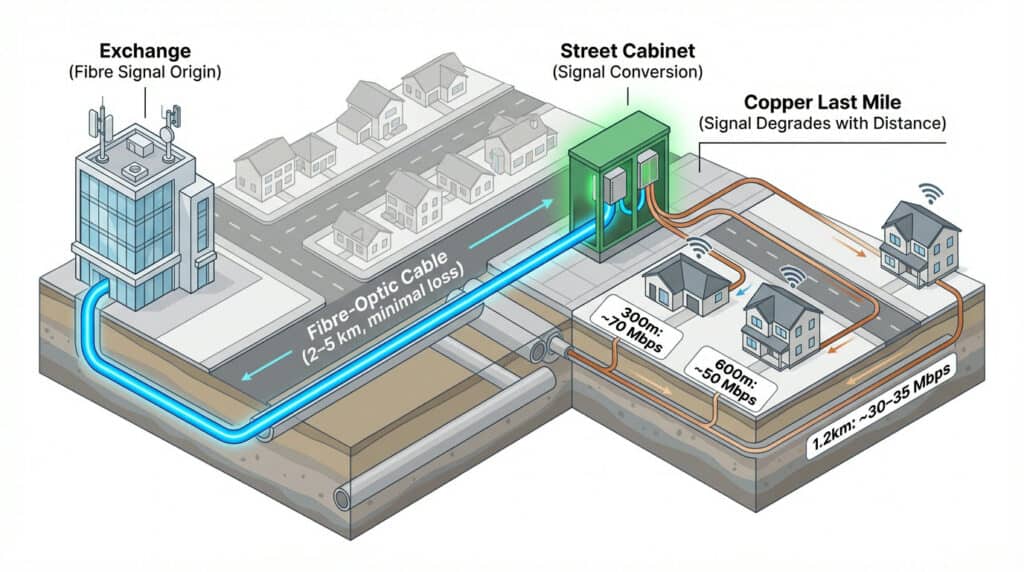
FTTC’s infrastructure follows a three-stage pathway:
- Exchange to Cabinet (Fibre): Signals originate at your local telephone exchange as high-frequency data pulses traveling through fibre-optic cables. These light-based signals experience virtually no degradation across the 2–5 km distance to the street cabinet.[11]
- Street Cabinet Operations: At the cabinet, electronic equipment (called a DSLAM—Digital Subscriber Line Access Multiplexer) converts the incoming fibre signal into a format compatible with copper telephone lines. This equipment is powered by electricity and requires regular maintenance.[13]
- Cabinet to Home (Copper): The converted signal travels through standard copper telephone wires—originally installed for voice calls decades ago—from the cabinet to your home. This final connection is where signal degradation becomes unavoidable. Over 300–500 metres of copper, the signal weakens; beyond 2–3 kilometres, speeds can drop to 30–40 Mbps or lower.[13][15]
FTTC vs FTTP vs ADSL: Key Differences

The three dominant fixed-line broadband technologies in the UK occupy distinct tiers in terms of infrastructure, speed, and reliability:
| Aspect | FTTC | FTTP | ADSL |
|---|---|---|---|
| Infrastructure | Fibre to cabinet; copper last mile | Fibre all the way to home | Copper telephone lines only |
| Download Speeds | 38–80 Mbps (real-world: 35–76 Mbps) | 145–2,500+ Mbps | 2–17 Mbps (typically 5–10 Mbps) |
| Upload Speeds | 5–20 Mbps (max ~15 Mbps real-world) | 100–1,000 Mbps (symmetrical) | ~1 Mbps |
| Latency | 30–60 ms average (up to 13.6 ms in tests) | 8–15 ms | 50–100+ ms |
| Distance Sensitivity | High (speeds drop 30–40% per additional km from cabinet)[13][15] | None (consistent speeds regardless of distance from exchange)[15] | Very high (speeds halve beyond 1.5 km) |
| UK Availability | 97% of premises | 77.8% of premises (Q2 2025) | Declining; being phased out |
| Future-Proof | No (limited by copper bottleneck)[15] | Yes (software upgrades enable faster speeds)[15] | No |
| Best For | Budget-conscious; basic streaming; light browsing | Gamers; content creators; remote workers | Rural areas with no alternatives (declining) |
Key Insight: FTTC represents a transitional technology. It improved upon ADSL for millions of homes but is increasingly constrained by its copper final mile—a limitation FTTP eliminates entirely by delivering fibre directly to premises.
Why FTTC Matters Today
Despite its limitations, FTTC remains the primary broadband technology for roughly 22% of UK premises—primarily in suburban and rural areas where FTTP deployment hasn’t yet reached. For budget-conscious households, FTTC offers a cost-effective step up from ADSL, typically priced £20–30 per month for 50–67 Mbps packages.
However, the landscape is shifting. FTTP coverage reached 77.8% of the UK by Q2 2025, growing 15.3% year-over-year. Simultaneously, Openreach has stopped selling new FTTC connections and plans to retire the entire copper network by the end of 2025, with full decommissioning by 2027.[25] This means FTTC’s window as an “upgrade option” is closing—existing customers will eventually face migration to FTTP as copper infrastructure is withdrawn. 2
Understanding FTTC today matters because millions of users still depend on it and need to know whether their current connection suits their needs or if an upgrade is necessary before the transition deadline arrives.
FTTC Specifications Explained
Real-World Download Speeds
Advertised FTTC speeds of “up to 76 Mbps” can be misleading. Real-world performance depends heavily on distance from the street cabinet, copper cable quality, line congestion, and time of day.
Speed tiers and realistic delivery:
- FTTC 38 Mbps package: Typically delivers 34–38 Mbps (95–100% of advertised speed). Suitable for single-user streaming in HD or light browsing.
- FTTC 52 Mbps package: Real-world delivery ~48–52 Mbps, depending on distance. Supports 4K streaming on one device and standard browsing on others.
- FTTC 76 Mbps package: The maximum for standard FTTC on Openreach infrastructure. Users close to cabinets (within 300 metres) achieve 70–76 Mbps; those further away (800+ metres) may see only 50–60 Mbps.3
Why advertised ≠ actual: ISPs publish speeds as “up to X Mbps”—a theoretical maximum under ideal conditions. Network congestion during peak hours (7 pm–11 pm), shared cabinet bandwidth, and copper line age all compress real performance.[11]
Upload Speeds (The Weak Point)
FTTC’s Achilles’ heel is upload speed—a critical factor for video conferencing, cloud backups, and content creation. The maximum upload speed on UK FTTC is approximately 15–20 Mbps in ideal conditions, though most users experience 8–15 Mbps in practice.
Real-world upload scenarios:
- 10 Mbps: Large file uploads (100 MB) take ~90 seconds; moderate video conferencing (720p) is functional.
- 15 Mbps: Better for video conferencing; 100 MB file uploads complete in ~60 seconds.
- 20 Mbps (rare): 4K video streaming to YouTube is possible, though risqué; 100 MB uploads complete in ~45 seconds.[24]
By contrast, FTTP delivers 100–1,000 Mbps upload speeds—matching download speeds symmetrically—which explains why content creators, remote workers with heavy file-sharing requirements, and online gamers streaming gameplay should avoid FTTC.
Latency & Reliability
Latency (measured in milliseconds) represents the delay between sending a request and receiving a response. Lower latency matters for real-time activities: gaming, video calls, and interactive applications.
FTTC latency performance:
- Typical range: 30–60 ms average (measured across the network)
- Best-case (test conditions): 10–13.6 ms (Plusnet 66 Mbps packages)
- Worst-case: 50+ ms during peak congestion
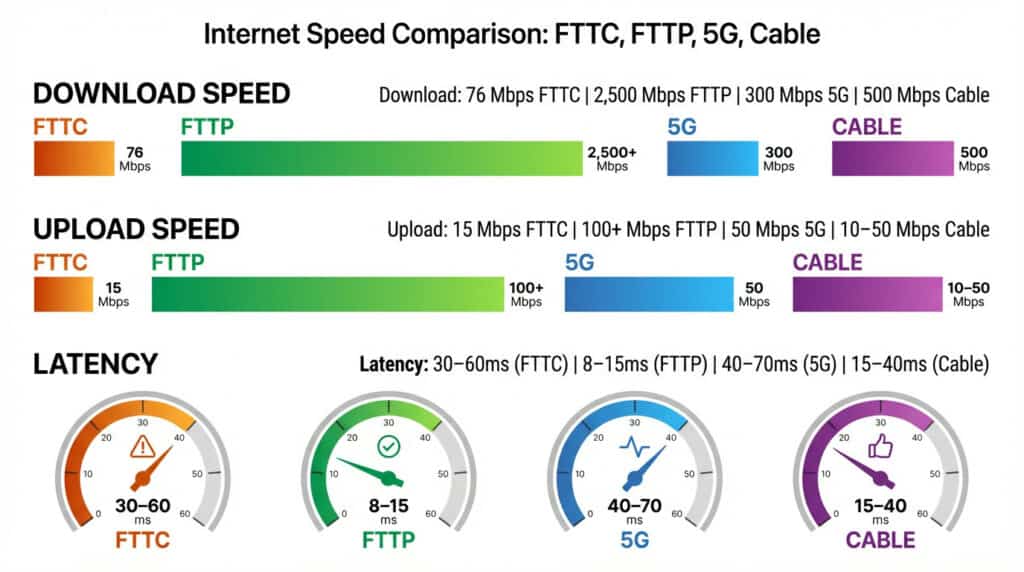
For context, FTTP achieves 8–15 ms consistently, while 5G broadband ranges from 40–70 ms—making FTTC marginally better than 5G for latency-sensitive work but slower than full fibre. Competitive online gaming—particularly esports-grade games like Counter-Strike or Valorant—requires latencies below 20 ms; FTTC sits on the edge of acceptability.4
Reliability: FTTC is generally stable within a single premises, but the copper infrastructure is susceptible to weather interference, moisture damage, and electromagnetic interference. During heavy rain or extreme cold, some users report speed drops of 10–20%. By contrast, fibre-optic cables in FTTP are immune to weather and electromagnetic interference, making them inherently more reliable.
Distance & Speed Degradation
This is the critical FTTC limitation: every additional hundred metres of copper distance from the street cabinet reduces signal strength, and with it, available bandwidth.
Distance impact on real FTTC speeds:
| Distance from Cabinet | Typical Download Speed | Upload Speed | Latency |
|---|---|---|---|
| 200–300 m (ideal) | 70–76 Mbps[15] | 15–20 Mbps | 10–15 ms |
| 500–600 m (typical suburban) | 55–65 Mbps[15] | 10–15 Mbps | 15–20 ms |
| 800–1,000 m | 40–50 Mbps[15] | 8–12 Mbps | 20–30 ms |
| 1.5+ km (rural) | 30–40 Mbps[13] | 5–8 Mbps | 30–40+ ms |
This distance penalty is fundamental to FTTC technology—it cannot be overcome with better equipment or provider optimization. The copper wire itself has physical limits on signal transmission at high frequencies.5
Compare to FTTP: A property 2 kilometres from the exchange receiving FTTP still achieves the full 145+ Mbps available in their package tier.[15] Distance becomes irrelevant with fibre because light pulses transmit through glass with virtually no degradation over these short distances.[15]
FTTC vs FTTP vs 5G Broadband (Comparison)
Side-by-Side Comparison
This comparison reveals where FTTC excels and where it falls short against alternative broadband technologies available in most UK locations:
| Metric | FTTC | FTTP | 5G Broadband | Cable (Virgin Media) |
|---|---|---|---|---|
| Max Download Speed | 76 Mbps | 2,500+ Mbps | 300 Mbps (5G Home) | 500+ Mbps (DOCSIS 3.1) |
| Max Upload Speed | 15–20 Mbps | 100–1,000 Mbps | 50 Mbps | 10–50 Mbps |
| Typical Latency | 30–60 ms | 8–15 ms | 40–70 ms | 15–40 ms |
| Speed Consistency | Distance-dependent; degrades 30–40% per km from cabinet[13][15] | Consistent regardless of distance[15] | Highly variable; weather and congestion dependent | Shared bandwidth; peaks during usage |
| Upload Symmetry | Asymmetrical (weak uploads) | Symmetrical (equal up/down) | Asymmetrical (slower uploads) | Asymmetrical (improving with DOCSIS 4.0) |
| UK Availability | 97% of premises | 77.8% of premises (Q2 2025) | Growing; area-dependent (~80% urban coverage) | ~55% of UK (Virgin Media footprint) |
| Reliability | Moderate (weather/interference sensitive) | Excellent (immune to weather)[15] | Moderate (signal quality varies) | Good (established infrastructure) |
| Installation | Typically requires engineer visit to establish copper connection | Engineer required for fibre termination | No installation needed (wireless) | Engineer required; fibre + coaxial installation |
| Cost (Entry-Level) | £20–30/month for 50–67 Mbps | £30–50/month for FTTP 150 Mbps | £25–40/month (trial pricing variable) | £25–35/month for M50 tier |
| Future-Proof Rating | ❌ No (being phased out; copper switch-off 2025–2027)[25] | ✅ Yes (software upgrades enable faster speeds)[15] | ⚠️ Partial (expanding, but latency limits gaming/real-time apps) | ✅ Yes (DOCSIS 4.0 enables symmetrical speeds) |
Key Takeaway: FTTC remains the most widely available but least future-proof option. FTTP is superior in nearly every metric but is not yet universally available. Cable and 5G fill geographic gaps where fibre hasn’t deployed.
When FTTC Wins, When It Loses
✅ FTTC Wins When:
- Budget is the primary constraint: Entry-level FTTC at £20–25/month undercuts FTTP (£30+) and fibre alternatives, making it ideal for cost-focused households with basic internet needs.
- Availability is limited: In rural or suburban areas where FTTP and cable haven’t yet deployed, FTTC may be the only wired option above ADSL.
- Latency doesn’t matter: For streaming, browsing, and standard video calls, FTTC’s 30–60 ms latency is acceptable. Online shopping, email, and social media experience no meaningful impact.
- Single-user households: A person living alone consuming HD streaming and light browsing needs only 30–50 Mbps, which FTTC comfortably provides near cabinets.
❌ FTTC Loses When:
- Gaming is your priority: Competitive multiplayer games require latencies below 20 ms; FTTC’s 30–60 ms range induces lag that impacts performance. FTTP’s 8–15 ms is dramatically better.
- Upload-heavy work matters: Videographers, content creators, and professionals regularly uploading large files can’t function on 15 Mbps uploads. FTTP’s 100+ Mbps is 6–7× faster.[24]
- Multiple users simultaneously: Households with 4+ people video conferencing, streaming, and working at once quickly exhaust FTTC’s 76 Mbps ceiling. FTTP handles gigabit-level multi-user scenarios.
- Future-proofing is important: FTTC is being phased out; customers cannot upgrade speeds indefinitely. FTTP technology supports 10 Gbps+ theoretical maximums.[25]
- Reliability matters: Weather-sensitive applications (security cameras, real-time monitoring) suffer on FTTC’s copper infrastructure but thrive on FTTP’s weather-immune fibre.
Cost-Benefit Analysis
FTTC’s Value Proposition:
FTTC offers the lowest total cost of ownership for single-user, light-usage households in areas where FTTP is unavailable or upgrade costs are prohibitive. A user paying £25/month for 50 Mbps FTTC vs. £45/month for FTTP 150 Mbps saves £240/year while achieving adequate performance for Netflix, browsing, and email.
The Tradeoff:
This cost saving evaporates if your needs exceed FTTC’s capabilities:
- Remote workers paying £240/year less for FTTC but suffering productivity losses due to 15 Mbps upload speeds lose more in lost productivity than they gain in monthly savings.
- Gamers on FTTC spending monthly on competitive gaming platforms while experiencing lag-induced losses offset the cost advantage.
- Multi-user households where congestion necessitates peak-hour slowdowns find the budget savings negated by service quality degradation.
The Real Cost: When accounting for service quality, reliability, and longevity (FTTC discontinuation deadline 2025–2027), FTTP becomes the economically rational choice for most users despite higher upfront cost.[25]
Best FTTC Providers in 2026
FTTC is delivered by dozens of ISPs in the UK, but they all rely on the same underlying infrastructure: BT Openreach’s copper telephone network and fibre-to-cabinet backbone. This means speed and availability are largely standardized, and your choice comes down to customer service, contract terms, bundling options, and value pricing.
BT (Openreach Backbone Provider)
BT Broadband
Fast Reliable Nationwide Broadband
✅ Guaranteed minimum speeds up to 900 Mbps.
✅ Highly rated BT Smart Hub routers
✅ Great customer support with quick response rates.
Coverage: 98%+ of UK premises for FTTC
FTTC Speed Tiers:
- BT Superfast Fibre Essential: 36 Mbps
- BT Superfast Fibre 1: 50 Mbps
- BT Superfast Fibre 2: 67 Mbps
Typical Pricing: £20–30/month
Strengths:
- Widest availability (98%+ coverage)
- Bundling options (BT TV, phone, mobile)
- Longest established provider; strong technical support
- Stay Fast Guarantee on speeds[10]
Weaknesses:
- Price-wise, not always the cheapest option
- Customer service reputation mixed (Ofcom satisfaction: 88%)[10]
- Not proactively pushing customers to FTTP migration
Sky (Major FTTC Reseller)
Sky Broadband

Highly rated service Great Hardware
✅ Packages offering speeds up to 900 Mbps.
✅ Low latency for competitive gaming
✅ Great customer support with quick response rates.
Coverage: Nationwide FTTC availability (resells Openreach)
FTTC Speed Tiers:
- Sky Superfast: 38 Mbps
- Sky Superfast 2: 67 Mbps[10]
Typical Pricing: £22–32/month
Strengths:
- Competitive pricing for entry-level plans
- Sky TV bundling (strong value for TV + broadband customers)
- Consistent latency performance (6.6 ms recorded in tests)
Weaknesses:
- Ofcom customer satisfaction lower than BT (78%)[10]
- No 18-month contract option (longer contract lock-in)
- Upload speeds limited to FTTC ceiling (~15 Mbps max)
TalkTalk (National Coverage)

Coverage: Nationwide FTTC availability (Openreach reseller)
FTTC Speed Tiers:
- TalkTalk Superfast: 38 Mbps
- TalkTalk Superfast 2: 67 Mbps
- TalkTalk G.fast (emerging): 150–250 Mbps upload speeds up to 50 Mbps[24]
Typical Pricing: £18–28/month (FTTC); £35–45/month (G.fast)
Strengths:
- Cheapest entry-level FTTC packages (from £18/month)
- G.fast upgrade available in select areas (4× faster than standard FTTC with superior uploads)[24]
- Phone + broadband bundling standard
Weaknesses:
- Customer satisfaction historically lower (Ofcom: 78%)[10]
- 18-month contract standard; less flexibility
- G.fast availability still limited to trial areas
Secondary Providers (EE, Plusnet, Vodafone)
EE: Mobile + FTTC bundling, typically 67 Mbps packages, £25–35/month. Best for customers also buying EE mobile services.[10]
EE Broadband

Powered by BT With Great Hardware
✅ You crave blistering speeds (1.6Gbps is overkill, but future-proof).
✅ Gaming or WFH is non-negotiable (hello, Game Mode!).
✅ You value quick customer support and low complaint rates.
Plusnet: Budget-focused reseller; 66 Mbps packages from £20/month. Recorded best latency performance in independent tests (10.1 ms for 66 Mbps packages). Good customer support reputation.[10]
Vodafone: Mobile bundling focus; 67 Mbps packages, £26–32/month. Highest latency variance (13.6 ms recorded). Bundling value proposition stronger than standalone broadband.
Vodafone Broadband

Great Value For Money Great Hardware
✅ Packages offering speeds up to 1.1 Gbps.
✅ Latest Wi-Fi hardware eliminating dead zones.
✅ Great customer support with quick response rates.
Coverage & Speed Tiers Summary
All FTTC providers offer similar speed tiers (38, 50, 67 Mbps) because they share Openreach infrastructure. The differentiator is pricing, customer service, contract flexibility, and TV/mobile bundling.
For best value:
- Budget-conscious: TalkTalk (from £18/month)
- Reliability-focused: BT or Plusnet (superior support; Plusnet better latency)
- Bundling: Sky (TV value), EE/Vodafone (mobile integration)
- Upgrade path: TalkTalk G.fast (where available) provides FTTC-like pricing with 4× speeds and superior uploads
Who Should Choose FTTC?
Budget-Conscious Consumers ✓
FTTC is ideal for households prioritizing monthly cost over peak performance. Entry-level FTTC at £18–25/month is 40–50% cheaper than FTTP (£30–50/month), representing £144–384/year in savings.[10]
Conditions: Single-occupant households, light browsing and HD streaming (not 4K), no video conferencing for work, no gaming beyond casual mobile games.
Remote Workers (Conditional) ⚠️
FTTC is risky for remote workers dependent on reliable upload speeds. Video conferencing works (720p video requires ~3 Mbps upload), but:
- Not suitable if: You regularly upload files >100 MB, require 4K video conferencing, or depend on cloud backup of large datasets. FTTC’s 15 Mbps upload ceiling creates bottlenecks.
- Acceptable if: Your work involves light email, document editing in Google Workspace/Office 365, and standard Zoom meetings (1 Mbps per participant).
Better option: FTTP (100+ Mbps uploads) or Cable with DOCSIS 4.0 (emerging symmetrical speeds).6
Gamers ❌ Not Recommended
FTTC fails for competitive gaming due to latency. While 30–60 ms supports casual gaming (single-player, turn-based), competitive titles require <20 ms:
- Counter-Strike, Valorant, Fortnite, Apex Legends: All require <20 ms for fair competitive play
- FTTC’s 30–60 ms range induces visible lag affecting aim, reaction time, and ranking progression
Additionally: FTTC’s weak upload speeds (15 Mbps) make streaming gameplay to Twitch/YouTube practically impossible at quality settings above 720p.[24]
Better option: FTTP (8–15 ms latency; 100+ Mbps uploads for streaming).
Content Creators ❌ Not Suitable
FTTC is unsuitable for any content creation workflow:
- Video editors: 15 Mbps upload cannot efficiently transmit large project files (2–10 GB) to cloud storage. A 5 GB file upload takes ~45 minutes on FTTC vs. ~5 minutes on FTTP (100 Mbps).[24]
- Photographers: Cloud backup of raw image libraries (50+ GB) becomes impractical. 100 GB backup takes ~24 hours on FTTC vs. ~2 hours on FTTP.
- Streamers: 4K streaming requires 8–15 Mbps upload; FTTC’s 15 Mbps maximum leaves no headroom for quality or bitrate stability.[24]
Better option: FTTP or Cable with DOCSIS 4.0 (emerging; currently limited to Virgin Media in select areas).
Rural Residents (Best Available Option) ✓
FTTC is often the best available option in rural areas where FTTP deployment lags. For properties 2+ kilometres from urban centres, FTTC’s 30–40 Mbps (distance-dependent) still represents a significant upgrade over ADSL (~5 Mbps).[13][15]
Timeline: FTTP expansion targets rural areas, but deployment timelines vary. Check coverage at your postcode; many rural areas won’t see FTTP until 2025–2026.
Important: If you’re in a rural area dependent on FTTC and the copper switch-off deadline approaches (December 2025), plan proactively for FTTP migration or backup internet (satellite, 5G).7
Small Business (Limitation: Upload Speed) ⚠️
FTTC is marginal for small business:
Works for:
- Small office (2–3 staff) with light file sharing, email-based customer communication, cloud-hosted CRM (e.g., Salesforce, HubSpot)
Fails for:
- Businesses handling client file uploads/downloads, multiple video conferencing participants, or cloud backup of critical business data. 15 Mbps upload becomes a bottleneck quickly.
- Architecture/design firms, video production agencies, or data-intensive services cannot function on FTTC.[24]
Better option: FTTP or commercial cable (Virgin Media Business offers dedicated upload guarantees).
Is FTTC Right for You?
FTTC remains the most widely available broadband technology in the UK—accessible to 97% of premises—but it’s simultaneously a transitional technology reaching the end of its lifecycle. For budget-conscious households in areas without FTTP access, FTTC delivers adequate performance for streaming, browsing, and email at £18–30/month.
However, several realities reshape the evaluation:
FTTC’s limitations are fundamental: The copper final mile cannot deliver symmetrical speeds, low latency, or consistency over distance. These aren’t problems that better equipment or ISP optimization can fix—they’re physics. Content creators, gamers, and heavy remote workers consistently outgrow FTTC.
The timeline is closing: Openreach stopped selling new FTTC connections in 2024–2025, with the entire copper network scheduled for retirement by the end of 2025. Existing customers face forced migration to FTTP or alternatives within 2–3 years. Budgeting for an upgrade today avoids disruption later.
FTTP is increasingly affordable: Entry-level FTTP has dropped to £30–40/month, narrowing the gap with FTTC. For most households with multi-user needs, the £10–15/month premium is justified by the 10–30× speed improvement and future-proofing.
Make a decision based on your needs: If you live alone, stream Netflix in HD occasionally, and work in email-only roles, FTTC works—for now. If you video conference, share files, or game competitively, FTTP is no longer optional. If you’re rural and FTTP isn’t available yet, FTTC is your best option—but plan your migration before 2027.[22][25]
Common Questions & Troubleshooting (FAQ)
Why is my FTTC speed slower than advertised?
FTTC speeds are advertised as “up to 76 Mbps,” but real-world delivery depends on several factors:
Distance from cabinet: Every 100 metres of additional copper distance reduces speed. A property 300 metres from the cabinet may see 70–76 Mbps; one 1 km away may see 40–50 Mbps. This is fundamental to the technology—copper has physical limits on signal transmission at high frequencies.[13][15]
Network congestion: During peak hours (7 pm–11 pm), shared cabinet bandwidth gets congested. Multiple users downloading simultaneously compress available bandwidth. Peak-hour slowdowns of 10–20% are normal.[11]
Copper line quality: Older copper infrastructure, moisture damage, or corroded connections degrade signal. Your ISP can run a line test to check for physical degradation.[13]
Router placement: Poor WiFi signal (not broadband speed itself) makes it seem slower. Move your router centrally and away from interference (microwaves, cordless phones).
What to do: Run a speed test at speedtest.net during off-peak hours (late morning or early afternoon). If you’re consistently 20%+ below advertised speeds, contact your ISP for a line quality check.
Can I upgrade from FTTC to FTTP?
Yes, but timeline varies. FTTP availability is determined by your postcode. Use the Ofcom checker or your ISP’s coverage map to see if FTTP is available or planned for your address.
If FTTP is available now: Contact your ISP; most offer seamless upgrades with minimal downtime (typically a few hours).
If FTTP is planned: Timelines vary from months to 2+ years depending on your area. Rural areas remain lower priority; urban/suburban areas are typically prioritized.
If FTTP is unlikely: Consider alternative options—5G broadband (if coverage available), Cable (Virgin Media, if in footprint), or G.fast (emerging; limited availability).[22][25]
Is FTTC being phased out?
Yes. BT Openreach has stopped selling new FTTC connections as of 2024–2025. The copper network is planned for retirement by the end of 2025, with full decommissioning by 2027.[22][25]
What this means:
- New customers: Cannot order FTTC; must choose FTTP, Cable, 5G, or alternative if available.[22]
- Existing customers: Services remain operational through 2025–2027. However, plan migration to FTTP (or alternative) to avoid service disruption when copper is retired.[22][25]
Why? Copper infrastructure is ageing, costly to maintain, and cannot deliver modern broadband speeds. Fibre-optic and emerging technologies are replacing it.[22]
What’s the upload speed really like?
The maximum FTTC upload speed in real-world conditions is 15–20 Mbps—significantly lower than download speeds. In practical terms:
- 8–10 Mbps: Typical for most users and packages
- 15–20 Mbps: Achievable only on optimal lines near cabinets
What this enables:
- Large file uploads (100 MB): ~60–90 seconds
- 720p video conferencing: Functional but not ideal
- 4K video streaming: Impractical (requires 8–15 Mbps sustained)
- Cloud backup (100 GB): ~24 hours
By contrast, FTTP delivers 100–1,000 Mbps upload speeds, making the same tasks 50–100× faster.
How does distance from cabinet affect speed?
Fundamental principle: Copper cables experience signal degradation over distance. The farther from the cabinet, the weaker the signal, and the lower the achievable speed.
Real-world degradation:
| Distance from Cabinet | Speed Impact | Example Scenario |
|---|---|---|
| 0–300 m | No meaningful loss | Suburban home close to cabinet: 70–76 Mbps |
| 300–600 m | Moderate loss (5–15%) | Typical suburban home: 60–70 Mbps |
| 600–1,000 m | Significant loss (15–30%) | Suburban/rural edge: 50–65 Mbps |
| 1–1.5 km | Severe loss (30–50%) | Rural area: 40–50 Mbps |
| 1.5+ km | Critical loss (50%+) | Remote rural: 30–40 Mbps or lower |
This degradation cannot be overcome with better routers, optimization, or ISP upgrades. It’s a property of copper wire at the frequencies FTTC uses.
FTTP eliminates this problem: Fibre-optic signals travel without meaningful degradation over several kilometres, so distance becomes irrelevant.[15]
Sources Cited:- Openreach – Fibre to the Cabinet Broadband Providers
https://www.openreach.com/fibre-broadband/fttc-providers[↩] - Point-Topic – UK broadband availability in Q2 2025: FTTP approaching 80%
https://www.point-topic.com/post/uk-broadband-availability-in-q2-2025-fttp-approaching-80[↩] - Amvia – FTTC Speeds: How Fast
https://www.amvia.co.uk/blog/fttc-speeds[↩] - Reddit – FTTB vs 5G?
https://www.reddit.com/r/nbn/comments/1ar2wpv/fttb_vs_5g/[↩] - ISPreview – Study Tests the Theoretical Limits of Copper Line Broadband
https://www.ispreview.co.uk/index.php/2022/04/study-tests-the-theoretical-limits-of-copper-line-broadband.html[↩] - Medux – FTTH vs DOCSIS: Gigabit race for the best Customer Experience
https://medux.com/blog/ftth-vs-docsis-the-gigabit-broadband-race-for-the-best-customer-experience[↩] - EC2 IT – Are you ready for the UK’s Copper Broadband Switch-Off?
https://www.ec2it.co.uk/it-news/are-you-ready-for-the-uk-s-copper-broadband-switch-off[↩]



