


Getting gigabit speeds used to be impossible in most of the UK—but wireless technology is changing that. 5G broadband delivers home internet without copper wires, fibre cables, or engineer visits. If you live in an area where fibre won’t reach for years, or you’ve grown tired of slow FTTC connections, wireless 5G offers a genuine alternative.
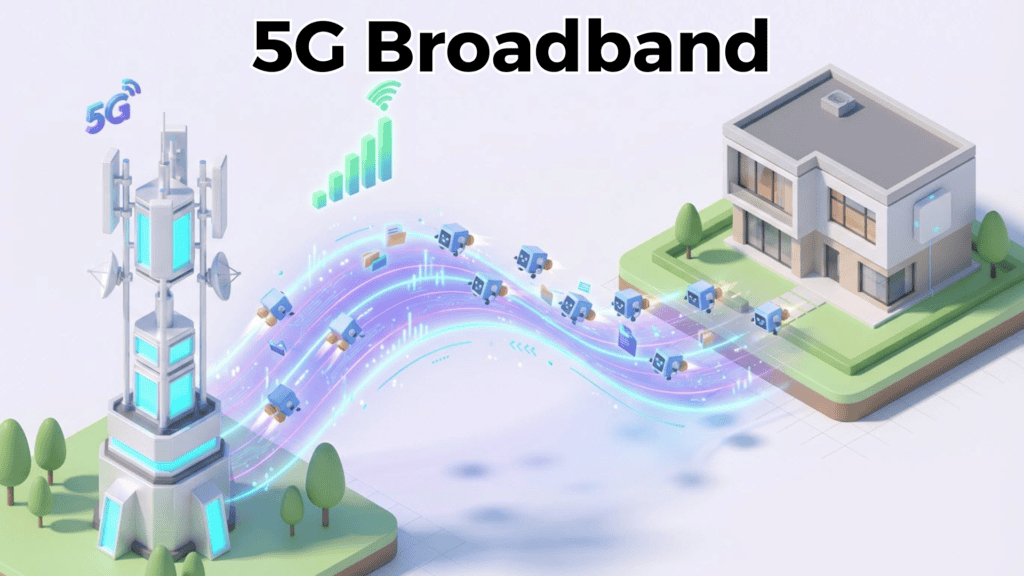
This guide explains what 5G Broadband actually is, how it compares to FTTP, FTTC, and Satellite Broadband, which providers lead the market, and whether it’s right for your home or business.
For a complete overview of all broadband technologies, see our Broadband Fundamentals: The Complete UK Guide for 2026.
What is 5G & Wireless Broadband? (Definition & How It Works)
What is 5G Broadband?
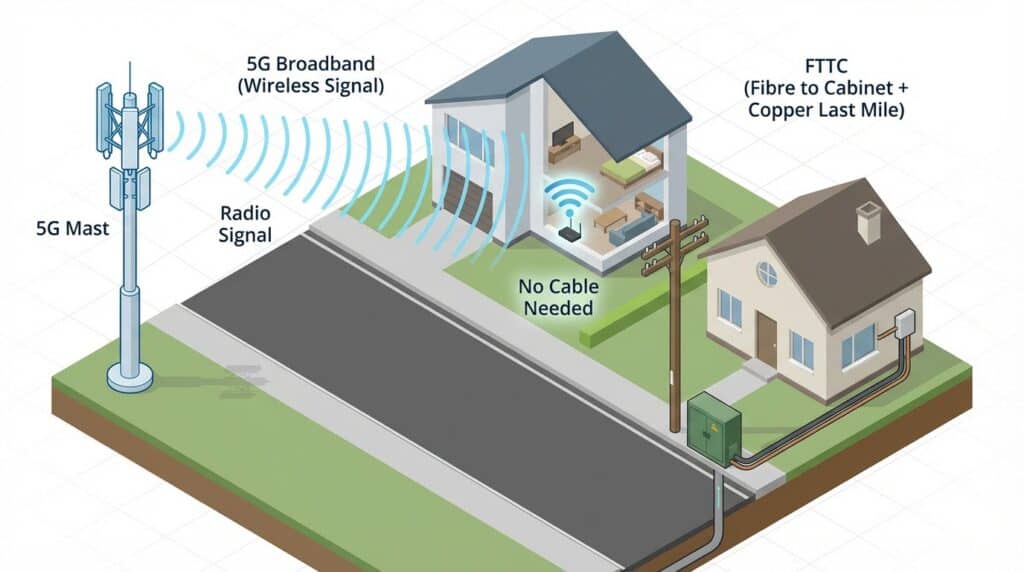
5G Broadband is a wireless internet service delivered directly to your home via radio signals from nearby 5G mobile masts. Unlike traditional broadband—which relies on cables running underground or along poles into your property—5G needs no physical infrastructure inside your home beyond a small indoor hub or router.
The technology uses high-frequency radio waves to transmit data between the network and your home. These signals travel through the air, which means installation is simple: the provider sends you a router, you plug it in, and within minutes you have internet. No landline required, no engineer visit needed, no waiting weeks for an installation.
How 5G Broadband Works: The Infrastructure
5G broadband infrastructure follows this path:
- 5G Mast – Located on rooftops, street poles, or towers within a few kilometres of your home, these masts transmit radio signals.
- Radio Signal Transmission – The mast sends high-frequency radio waves to a receiving antenna in your home’s router (or outdoor hub if needed).
- Home Hub/Router – Your indoor device converts the radio signal into WiFi, providing internet to all your devices: laptops, phones, tablets, and smart home devices.
Unlike FTTP, which carries data as light pulses through fibre optic cables, 5G uses electromagnetic radio waves. This means no digging, no copper-to-fibre conversion bottlenecks, and no distance-based speed degradation like you’d experience with FTTC.
5G vs 4G LTE: Key Differences

Many users confuse 5G home broadband with the 5G mobile service on their smartphones. While they use the same underlying network, they’re different products.
4G LTE (your phone’s current standard):
- Typical speeds: 20–50 Mbps
- Designed for mobile use (moving between masts)
- Latency: 50–100ms
- Prioritizes coverage over speed
5G Broadband (home internet service):
- Typical speeds: 30–300 Mbps (varies by location and provider)
- Designed for stationary home use (one location)
- Latency: 40–70ms average
- Optimized for high-bandwidth applications (video streaming, gaming)
The key difference: 5G broadband providers optimize their network infrastructure specifically for high-speed, low-latency home internet delivery, whereas 4G is stretched thin across millions of mobile users constantly moving between cells.
Key Specifications at a Glance
Based on real-world testing across UK networks:1
| Metric | 5G Broadband | FTTP | FTTC | Satellite |
|---|---|---|---|---|
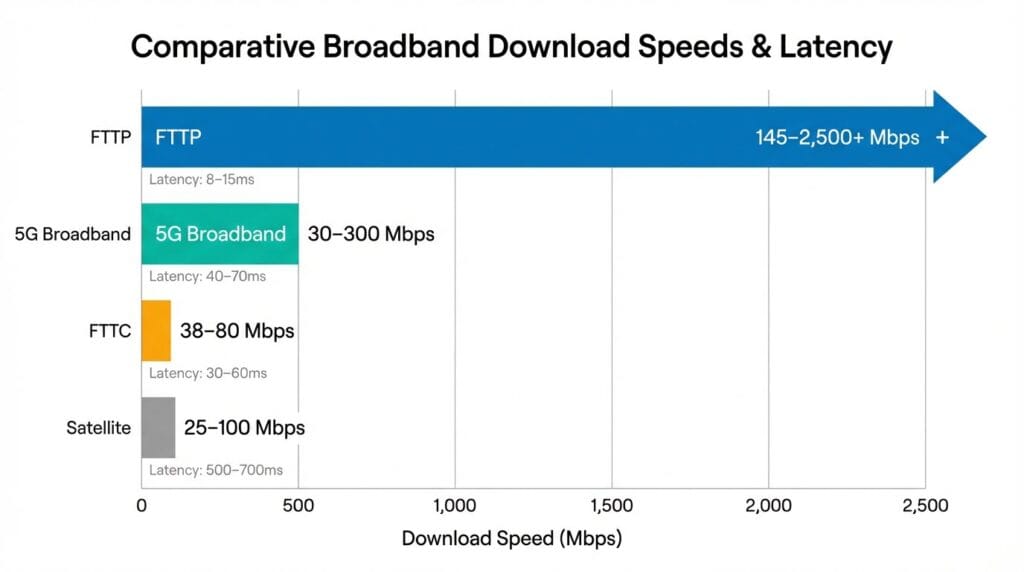
| Download Speed Range | 30–300 Mbps | 145–2,500+ Mbps | 38–80 Mbps | 25–100 Mbps |
| Upload Speed Range | 10–50 Mbps | 100–1,000 Mbps | 5–20 Mbps | 5–10 Mbps |
| Latency | 40–70ms | 8–15ms | 30–60ms | 80–150ms |
| Availability (UK) | 97% outdoors; lower indoors | 84% (Jan 2026) | 99% | Remote areas only |
| Setup Time | Minutes (plug-in) | Weeks (installation) | Weeks (installation) | Days–weeks |
| Equipment Cost | Free–£150 | Free–£100 | Free–£50 | £299–£600 |
| Typical Monthly Cost | £17–£60 | £25–£50 | £20–£35 | £75+ |
| Best For | Rural areas without fibre; backup internet; temporary homes | Content creators; gamers; future-proofing | Budget-conscious; basic browsing | Remote rural only |
5G & Wireless Broadband Specifications Explained
Real-World Speed Data: Download, Upload & Latency
Download Speeds – What You Actually Get:
5G broadband speed varies significantly based on:
- Network congestion – During peak hours (6–10 PM), shared network bandwidth slows speeds
- Distance from mast – Closer to a mast = faster speeds
- Local obstacles – Buildings, trees, weather conditions affect signal quality
- Provider network capacity – EE, Vodafone, Three, and O2 each have different infrastructure investment levels
Real-world median speeds (from Ofcom & Ookla data, Q4 2024–Q1 2025):2
- Three 5G: 208–276 Mbps typical; peaks of 681 Mbps
- Vodafone 5G: 138–162 Mbps typical; peaks of 354 Mbps
- EE 5G: 96–119 Mbps typical; peaks of 316 Mbps
- O2 5G: 114–146 Mbps typical; peaks of 315 Mbps
Note that Three leads significantly for speed, while EE leads for coverage reliability.
Upload Speeds – The Weak Spot:
One of 5G broadband’s limitations is asymmetrical upload performance. While downloads reach 30–300 Mbps, uploads typically max out at 10–50 Mbps. This matters less for casual users but becomes a bottleneck for content creators, video conferencing professionals, and cloud backup use cases.
For comparison:
- FTTP upload: 100–1,000 Mbps (symmetrical)
- 5G upload: 10–50 Mbps (asymmetrical)
- FTTC upload: 5–20 Mbps (asymmetrical)
Latency – Response Time That Matters:
Latency measures the delay between sending a request and receiving a response, measured in milliseconds (ms). Lower latency = faster interaction with responsive applications.
5G broadband latency: 40–70ms average
For context:
- FTTP latency: 8–15ms (excellent)
- FTTC latency: 30–60ms (acceptable)
- 5G latency: 40–70ms (acceptable for most uses, marginal for competitive gaming)
- Satellite latency: 80–150ms (unsuitable for real-time applications)
What can you do at different latencies?
- Under 20ms: Competitive esports (Counter-Strike, Valorant), high-frequency trading
- 20–50ms: Casual gaming, video conferencing, real-time multiplayer
- 50–100ms: Streaming, browsing, email, asynchronous work
- 100ms+: Not suitable for real-time interactive use
5G’s 40–70ms latency places it in the “casual gaming and video conferencing” category—adequate but not ideal for hardcore gamers.
Coverage & Availability in the UK
Outdoor 5G Coverage:
According to Ofcom’s November 2025 Connection Nations report, outdoor 5G coverage from at least one mobile operator is available to 97% of UK premises—up from 95% in 2024.3 However, this statistic hides important variations:
- EE 5G coverage: Largest footprint; available in 1,000+ UK towns and cities
- Vodafone 5G coverage: ~580+ towns and cities with variable coverage density
- Three 5G coverage: ~580+ towns and cities; typically faster speeds where available
- O2 5G coverage: 3,200+ towns and cities (largest declared coverage, but slowest speeds)
Indoor Coverage – The Real Problem:
The 97% figure measures outdoor coverage only. Indoors, 5G signal penetration is weaker because high-frequency radio waves struggle to pass through walls, windows, and structural materials. Many users report needing to place their router near a window or install an outdoor antenna hub to achieve advertised speeds.
Geographic Variation:
- Urban areas (London, Manchester, Birmingham): Excellent 5G coverage; speeds often 200+ Mbps
- Suburban areas: Good coverage; speeds 100–200 Mbps typical
- Rural areas with fibre: Increasingly competitive; 5G becoming backup-only
- Rural areas without fibre: 5G is primary option; availability still patchy
Signal Quality Factors: Weather, Obstacles & Distance
Unlike fibre, which is immune to weather and distance, 5G signal degrades under several conditions:
Weather Impact:
5G uses higher-frequency radio waves (24–28 GHz) than 4G, which makes them more susceptible to atmospheric interference. ((How Bad Weather Impacts Different Types of Internet: Fibre, Cable, 5G and Satellite – http://www.madtel.com/blog/2025/06/17/how-bad-weather-impacts-different-types-of-internet-fiber-cable-5g-and-satellite
- Heavy rain: Signal weakening of 5–15 dB (measurable speed drops of 20–40%)
- Dense fog: Signal scattering; typically 10% speed reduction
- Snowstorms: Significant signal blockage; potential 30–50% speed loss
- Clear weather: No degradation; baseline performance
For comparison, fibre experiences zero weather-related degradation. Satellite is far worse, suffering “rain fade” that can completely drop the connection.
Physical Obstacles:
5G signals degrade rapidly when blocked by:
- Brick/concrete buildings: 20–30% speed reduction
- Dense vegetation/trees: 15–25% speed reduction
- Metal structures: 40–60% attenuation (nearly complete blockage)
- Distance from mast: Speed halves roughly every 1–2 km beyond optimal range
Solution: Outdoor antenna hubs (mounted on your roof or external wall) often solve this, positioning the antenna in clear line-of-sight to the nearest mast.
Contract Terms & Pricing Ranges (January 2026)
Contract Flexibility:
All major 5G providers offer multiple contract lengths:
- 24-month contracts: Lowest monthly cost; most provider discount
- 12-month contracts: Moderate savings; better flexibility
- 30-day (rolling) contracts: Highest monthly cost; exit at any time
Pricing by Provider:
Three 5G Broadband:
Three Broadband

No Landline No Problem – Unlimited Data
✅ Renters or frequent movers: No installation = no landlord headaches.
✅ Rural users: If fibre hasn’t reached you, Three’s 4G/5G can be a lifeline.
✅ Temp setups: Think pop-up shops, festivals, or backup internet.
- 24-month contract: £16–£17/month (unlimited data, no upfront cost)
- 12-month contract: £24/month (unlimited data, no upfront cost)
- 1-month rolling: £28/month (unlimited data, no upfront cost)
Vodafone GigaCube 5G:
Vodafone 5G Broadband

Super Simple Setup DIY
✅ Offering speeds of 150-200 Mbps for its 5G
✅ Decent Wi-Fi coverage for an average home
✅ Good alternative if your fixed-line options are poor
- 24-month contract: £25/month (unlimited data, £15 upfront) OR £35/month (200GB, £45 upfront)
- 30-day rolling: £60/month (unlimited, £150 upfront) OR £40/month (200GB, £150 upfront)
- Average speeds: 150–200 Mbps on 5G
EE 5G Home Broadband:
EE Broadband

Powered by BT With Great Hardware
✅ You crave blistering speeds (1.6Gbps is overkill, but future-proof).
✅ Gaming or WFH is non-negotiable (hello, Game Mode!).
✅ You value quick customer support and low complaint rates.
- Pricing varies by location and availability; typically £30–£50/month
- Speeds vary: slower than Three, faster than O2
O2 5G (via Virgin Media):
- Available as add-on to Virgin Media broadband bundles
- No standalone pricing available; bundled only
Equipment Costs:
- Three: No upfront hardware cost (included in plan)
- Vodafone: £15–£150 upfront depending on contract length
- EE: Free–£150 depending on deal
5G & Wireless vs FTTP vs FTTC vs Satellite
Comparison Table: 5G vs FTTP vs FTTC vs Satellite
| Specification | 5G Broadband | FTTP | FTTC | Satellite |
|---|---|---|---|---|
| Download Speed | 30–300 Mbps | 145–2,500+ Mbps | 38–80 Mbps | 25–100 Mbps |
| Upload Speed | 10–50 Mbps | 100–1,000 Mbps | 5–20 Mbps | 5–10 Mbps |
| Latency | 40–70ms | 8–15ms | 30–60ms | 80–150ms |
| Availability (UK) | 97% outdoor; variable indoor | 84% | 99% | <5% (rural only) |
| Weather Dependent? | Yes (moderate impact) | No | No | Yes (severe impact) |
| Setup Time | Minutes | 2–4 weeks | 2–4 weeks | Days–weeks |
| Installation Cost | Free–£150 | Free–£100 | Free–£50 | £299–£600 |
| Monthly Cost | £17–£60 | £25–£50 | £20–£35 | £75+ |
| Best For | Rural without fibre; backup internet | Content creators; gamers; future-proofing | Budget-conscious; basic users | Remote rural only |
| Key Advantage | No installation; immediate service | Ultra-fast speeds; symmetrical uploads; low latency; future-proof | Widely available; affordable | Reaches anywhere with line of sight |
| Key Disadvantage | Weather dependent; weaker uploads; congestion during peak hours | Limited availability; higher cost | Slow speeds; weak uploads; distance-based degradation | Very high latency; weather vulnerable; expensive |
When 5G Wins vs When Fibre Wins
5G Broadband Wins When:
- No fibre availability within 3+ years – If your property is on a council deprioritisation list and gigabit rollout won’t reach you before 2028, 5G offers immediate high-speed internet today.
- You’re in a rural area with good 5G coverage – If you’re 2+ km from the nearest fibre cabinet but close to a 5G mast, wireless may deliver faster, more reliable service than degraded FTTC copper.
- You’re a backup internet user – 5G acts as an excellent failover if your fixed broadband goes down. Some remote workers deploy 5G specifically for redundancy.
- You’re in temporary housing – If you’re renting short-term, house-sitting, or in a property undergoing renovation, 5G’s plug-and-play setup beats waiting for installation appointments.
- You value simplicity over maximum speed – If your household needs 100–200 Mbps (sufficient for 4K streaming, video calls, and light gaming) and you can’t face copper cable installations, 5G delivers without hassle.

FTTP Wins When:
- You’re a content creator or upload-heavy user – FTTP offers 100–1,000 Mbps upload speeds; 5G maxes out at 50 Mbps. For YouTube creators, Twitch streamers, or cloud backup, fibre is non-negotiable.
- You need absolute latency consistency – FTTP latency is 8–15ms; 5G averages 40–70ms. Competitive gamers and high-frequency traders require fibre’s reliability.
- You want weather-proof internet – Fibre is completely immune to rain, snow, and fog. 5G degrades during storms.
- You’re future-proofing your property – FTTP future-supports multi-gigabit speeds (2.5–10 Gbps); 5G caps at ~300 Mbps.
- You have multiple users on one connection – FTTP’s symmetrical bandwidth handles heavy concurrent use better. 5G shared networks can get congested during peak hours in high-density areas.
Cost-Benefit Analysis
Upfront Costs:
- 5G: £0–£150 equipment + immediate service activation
- FTTP: £0–£100 equipment + £200–£500 installation fee (variable by provider)
- FTTC: £0–£50 equipment + £150–£300 installation fee
- Satellite: £299–£600 for dish + installation
Monthly Recurring Costs (January 2026):
- 5G: £17–£60/month (average £30–£40)
- FTTP: £25–£50/month (average £35)
- FTTC: £20–£35/month (average £25)
- Satellite: £75+/month (typically £75–£150)
5-Year Total Cost of Ownership:
Assuming a 24-month contract renewed twice:
- 5G: (£35/month × 60 months) + £100 equipment = £2,200
- FTTP: (£35/month × 60 months) + £400 installation = £2,500
- FTTC: (£25/month × 60 months) + £250 installation = £1,750
- Satellite: (£100/month × 60 months) + £500 equipment = £6,500
Verdict: FTTC is cheapest long-term; 5G is competitive if you factor in no installation wait time. Satellite is prohibitively expensive.
Availability Comparison: Geographic Spread
5G: 97% outdoor; uneven indoor; major urban areas saturated; rural variability by provider.
FTTP: 84% (Jan 2026); expanding ~3% annually; highest availability in cities and suburban areas; worst in remote rural.
FTTC: 99% (universal fallback); slowest speeds in rural areas due to distance from cabinet.
Satellite: <5% uptake; available everywhere with clear sky; typically last resort.
Best 5G & Wireless Broadband Providers (Coverage & Speed Tiers)
EE 5G: Coverage & Plans
EE Broadband
Powered by BT With Great Hardware
✅ You crave blistering speeds (1.6Gbps is overkill, but future-proof).
✅ Gaming or WFH is non-negotiable (hello, Game Mode!).
✅ You value quick customer support and low complaint rates.
Network Strengths:
- Largest declared 5G coverage footprint: 1,000+ UK towns and cities
- Strongest indoor coverage and penetration (EE only declares a location covered if 50% of geographic area has 5G—stricter standard than competitors)
- Consistent mid-range speeds: 96–119 Mbps typical (Q1 2025 Speedtest data)
- Best bundling options: Integrates 5G with fixed fibre (FTTP/FTTC) and mobile SIM plans
EE 5G Plans (January 2026):
EE primarily offers 5G as an add-on to fixed broadband bundles rather than standalone. Check EE’s website for current 5G home broadband availability in your area.
Coverage Check: EE postcode checker at EE.co.uk
Vodafone GigaCube 5G: Coverage & Plans
Vodafone 5G Broadband
Super Simple Setup DIY
✅ Offering speeds of 150-200 Mbps for its 5G
✅ Decent Wi-Fi coverage for an average home
✅ Good alternative if your fixed-line options are poor
Network Strengths:
- Fast mid-range speeds: 138–162 Mbps typical (Q4 2024 data)
- Flexible contract options: 24-month, 12-month, or 30-day rolling
- Decent coverage in ~580+ towns and cities
- Good bundling with Vodafone mobile plans for household discounts
GigaCube Plans (January 2026):
| Plan | Contract | Data | Monthly Cost | Upfront |
|---|---|---|---|---|
| GigaCube Unlimited | 24 months | Unlimited | £25/month | £15 |
| GigaCube 200GB | 24 months | 200GB | £35/month | £45 |
| GigaCube Unlimited | 30-day | Unlimited | £60/month | £150 |
| GigaCube 200GB | 30-day | 200GB | £40/month | £150 |
Note: Prices increase each April (increases of £2–£3/month typical).
Average Speeds: 150–200 Mbps on 5G (when close to mast).
Coverage Check: Vodafone coverage checker at Vodafone.co.uk/gigacube
Three 5G: Coverage & Plans
Three Broadband
No Landline No Problem – Unlimited Data
✅ Renters or frequent movers: No installation = no landlord headaches.
✅ Rural users: If fibre hasn’t reached you, Three’s 4G/5G can be a lifeline.
✅ Temp setups: Think pop-up shops, festivals, or backup internet.
Network Strengths:
- Fastest 5G speeds in the UK: 208–276 Mbps typical (Q4 2024); peaks of 681 Mbps
- Most aggressive pricing: £16–£17/month on 24-month contracts
- No upfront hardware costs on any contract length
- Excellent 30-day money-back guarantee (14-day cooling-off period)
Three 5G Plans (January 2026):
| Plan | Contract | Data | Monthly Cost | Upfront |
|---|---|---|---|---|
| 5G Broadband | 24 months | Unlimited | £16–£17/month | £0 |
| 5G Broadband | 12 months | Unlimited | £24/month | £0 |
| 5G Broadband | 1 month | Unlimited | £28/month | £0 |
Discounted price (£16/month) available for Black Friday 2025; standard rate £19/month.
Equipment: 5G Router included (no separate hardware costs).
Coverage Check: Three coverage checker at Three.co.uk
O2 5G (via Virgin Media): Coverage & Plans
Network Strengths:
- Widest declared coverage: 3,200+ UK towns and cities
- Slowest speeds: 114–146 Mbps typical (Q4 2024 data)
- Available only as add-on to Virgin Media broadband bundles (not standalone)
- Bundled Volt benefits: Speed boost up to 1 Gbps, double mobile data, roaming benefits
Coverage Check: O2 coverage checker at O2.co.uk
Availability: O2 5G home broadband is only available via Virgin Media bundles. Check Virgin Media’s website for Volt bundle pricing.
How to Check Your 5G Coverage
- Provider Websites:
- EE: ee.co.uk (postcode checker)
- Vodafone: vodafone.co.uk/gigacube (coverage map)
- Three: three.co.uk (coverage checker)
- O2: o2.co.uk (coverage map)
- Independent Coverage Maps:
- OpenSignal: opensignal.com/uk (crowdsourced real-world data)
- Speedtest.net: speedtest.net (speed test + coverage)
- Speed Test Your Location:
- Download Speedtest app and run tests at your intended location
- Real-world performance often differs from advertised speeds
- Ask Neighbours:
- If 5G is new to your area, ask people nearby about actual speeds and reliability
- Local Facebook groups often have real-world user feedback
Who Should Choose 5G & Wireless Broadband? (Use Cases)
Remote Workers: Why/Why Not?
Why 5G Works for Remote Work:
Remote workers typically need:
- Minimum 10 Mbps download for video conferencing, email, and cloud app access
- Consistent latency for real-time meetings
- Reliability for synchronous collaboration
5G delivers all three at speeds of 30–300 Mbps, well above minimums.
Typical Work Scenario (4–8 hours, one person):
- Video conferencing: 2.5–4 Mbps per video call
- Email and web browsing: 1–5 Mbps
- Cloud document editing (Google Workspace, Microsoft 365): 1–3 Mbps
- Concurrent use: 5–10 Mbps maximum
5G’s 40–70ms latency is acceptable for video calls (professional Zoom quality tops out at 150ms latency tolerance).
Why 5G Might Not Work:
- Household bandwidth sharing: If you have a partner also working from home, plus video streaming on another device, peak simultaneous demand can exceed 30 Mbps. 5G may struggle during peak hours (6–10 PM) in congested areas.
- Weather sensitivity: If your location experiences frequent heavy rain during your work day, signal degradation could disrupt calls.
- Upload bottleneck: If you upload large files (video renders, 4K footage, datasets), 5G’s 10–50 Mbps upload maxes out quickly. FTTP’s 100–1,000 Mbps upload is far superior.
Verdict: ✅ Suitable for single remote workers; ⚠️ marginal for households with multiple concurrent users; ❌ not suitable for heavy-upload work (video editing, content creation).
Gamers: Why/Why Not?
Why 5G Works for Gaming:
Casual gaming (Fortnite, Minecraft, Valorant) requires:
- Minimum 5 Mbps download (satisfied by 5G easily)
- Latency under 100ms (5G averages 40–70ms—acceptable but not ideal)
- Consistent jitter (response time variance)
5G latency sits in the “playable but not competitive” zone.
Latency Thresholds:
- Under 30ms: Professional esports (CSGO, Valorant ranked)
- 30–60ms: Casual competitive gaming; noticeable delay but acceptable for most players
- 60–100ms: Social gaming; lag becomes obvious but not game-breaking
- 100ms+: Unplayable for real-time multiplayer
5G at 40–70ms lands in the “casual competitive” bracket.
Why 5G Might Not Work:
- Peak-hour congestion: If your area has high 5G adoption, network contention during 6–10 PM gaming hours can spike latency to 80–120ms, destroying competitive gameplay.
- Jitter sensitivity: Wireless networks have higher jitter (variance in latency) than fixed lines. A single spike to 150ms mid-match is worse than consistent 60ms.
- Weather impact: Sudden storms can degrade latency and speeds mid-game.
- Download speed cap: If you want to download a 150 GB game, 5G at 100 Mbps takes 2 hours; FTTP at 1,000 Mbps takes 20 minutes.
Verdict: ✅ Suitable for casual gamers; ⚠️ marginal for competitive gamers; ❌ not suitable for esports-grade competitive play or large game downloads.
Content Creators: Why/Why Not?
Why 5G Doesn’t Work for Content Creation:
Content creators (YouTube, Twitch, TikTok) upload:
- YouTube shorts: 5–50 MB (manageable with 5G uploads)
- TikTok videos: 20–150 MB (manageable)
- Full YouTube video (4K 60fps): 2–5 GB (takes hours with 5G)
- Twitch live streaming: Requires consistent 5–10 Mbps upload (5G can do this, but unreliably)
The fatal issue: 5G upload speeds top out at 10–50 Mbps, often degrading to 5–10 Mbps during congestion.
Example Upload Times:
Uploading a 4K 10-minute YouTube video (~3 GB):
- FTTP at 500 Mbps upload: ~50 seconds
- 5G at 25 Mbps upload: ~20 minutes
- FTTC at 15 Mbps upload: ~30 minutes
For live streaming (Twitch requires 6 Mbps upload for 1080p 60fps):
- 5G provides this threshold but with minimal headroom
- Any network contention drops stream quality to 720p 30fps
Verdict: ❌ Not suitable for content creators. Recommend FTTP exclusively.
Budget-Conscious Users: Why/Why Not?
Why 5G Works for Budget Users:
- Lowest monthly cost: Three at £16–£17/month beats FTTC (£20–£25) and FTTP (£25–£50)
- No installation fees: Save £150–£500 vs fixed broadband engineer visits
- No long-term commitment: 30-day rolling contracts available; exit anytime
- Sufficient speeds: 100–200 Mbps covers casual browsing, streaming, and light gaming
5-Year Cost Comparison (Budget Scenario):
Cheapest option per technology:
- 5G (Three 24m contract): £17/month × 60 months = £1,020
- FTTC: £20/month × 60 months + £150 install = £1,350
- FTTP: £25/month × 60 months + £300 install = £1,800
- Satellite: £100/month × 60 months + £500 equip = £6,500
Verdict: ✅ Excellent choice for budget-conscious users if 5G coverage is available in your area.
Rural Residents: Why/Why Not?
Why 5G Works for Rural Areas:
- No cable infrastructure needed: Fibre rollout is slow to rural areas; 5G masts are increasingly deployed
- Immediate availability: While waiting 3–5 years for FTTP, 5G offers high-speed internet today
- Better than FTTC: If you’re 5+ km from the nearest cabinet, 5G at 100+ Mbps beats FTTC at 20–30 Mbps
- Backup redundancy: If your fixed broadband fails (common in rural areas), 5G offers emergency connectivity
Why 5G Might Not Work Rurally:
- Coverage gaps: Mast deployment in low-density rural areas is slower; some villages have 4G only, no 5G
- Distance from mast: If you’re 5+ km from the nearest 5G mast, signal degradation is severe; speeds drop to 10–30 Mbps
- Outdoor hub required: Many rural properties need roof-mounted external antenna hubs (£100–£300 additional cost) for any signal at all
- Weather impact: Rain and snow in rural areas without shelter hit 5G harder than urban rooftop-to-rooftop transmission
Verdict: ✅ Excellent for rural areas with 5G coverage; ⚠️ marginal for remote rural (5+ km from mast); ❌ unusable if no mast in range.
Backup Internet / Failover Use: Why Yes?
5G as a Failover Connection:
Professionals who depend on internet (remote work, VOIP services, live streaming) often deploy 5G as a redundant backup:
- Activation time: 5 minutes (plug in router)
- Cost: £17–£60/month for standby backup
- Reliability: Different infrastructure than fixed broadband; if FTTP fails, 5G often stays up
- Portable: Move the 5G hub between locations; not location-locked like fixed broadband
Typical Failover Setup:
- Primary broadband: FTTP (fast, reliable)
- Secondary broadband: 5G (slow, always available)
- Router: Dual-WAN capable (automatically fails over if primary drops)
Cost per month for redundancy: ~£17–£40 extra, justified by business continuity.
Verdict: ✅ Excellent for business failover and redundancy.
Is 5G & Wireless Broadband Right for You?
5G is your best choice if:
- You live in an area without FTTP, and it won’t arrive for 3+ years
- You need immediate broadband without engineer visits or installation delays
- You’re budget-conscious and want the cheapest reliable internet available
- You’re a casual user whose needs (browsing, streaming, video calls) max out at 100–200 Mbps
- You need a backup failover connection for business continuity
- You’re in a rural area with good 5G coverage but no fibre
FTTP is better if:
- You’re a content creator or heavy uploader
- You need the lowest possible latency (under 20ms) for esports or trading
- You want weather-proof connectivity with zero degradation
- You need future-proofing for multi-gigabit speeds
- Multiple household members use bandwidth simultaneously and peak-hour congestion concerns you
FTTC remains viable if:
- You’re budget-conscious and 50–80 Mbps is sufficient
- 5G coverage doesn’t exist in your area
- FTTP isn’t available and you’re willing to accept slower speeds
Satellite is last-resort only:
- Use only if no other option exists (true remote rural isolation)
- Prepare for high cost (£75+/month) and poor latency
Next Steps:
- Check your current coverage: Use provider postcode checkers (EE, Vodafone, Three, O2)
- Speed test your area: Download Speedtest app; run tests at your property location to see real speeds
- Compare providers:
– Three: Fastest speeds, lowest price (£16–£17/month on 24-month)
– Vodafone: Mid-range speeds, flexible contracts
– EE: Best coverage reliability; bundling with fixed broadband - Review use cases: Match your household’s needs (remote work, gaming, content creation, basic streaming) to the technology comparison table
- Plan for failover: Even if 5G is primary, consider a fixed broadband backup if you work from home
Common Questions & Troubleshooting (FAQ)
Is 5G faster than FTTP?
Short Answer: No. FTTP is 5–10x faster than 5G on average.
Long Answer:
FTTP download speeds range from 145–2,500+ Mbps. 5G tops out at 300 Mbps (usually 100–200 Mbps in real-world conditions).
However, speed alone isn’t the whole story:
- For basic use (browsing, streaming, video calls): The difference is unnoticeable. 50 Mbps and 500 Mbps both stream 4K flawlessly.
- For content creation or downloads: FTTP is dramatically superior. Uploading a 5 GB file takes 20 minutes on 5G vs 1 minute on FTTP.
- For future-proofing: FTTP will support multi-gigabit speeds in 20 years; 5G technology will plateau at ~1 Gbps.
Verdict: FTTP is faster in absolute terms, but 5G is sufficient for most home uses.
Will 5G replace fixed broadband?
Short Answer: No. 5G will complement fixed broadband, not replace it.
Long Answer:
5G has structural limitations that prevent full replacement:
- Spectrum scarcity: Radio spectrum is finite; 5G can’t match fixed broadband’s unlimited bandwidth potential.
- Physics constraints: Radio waves weaken over distance and through obstacles; fibre doesn’t.
- Latency floor: Wireless has inherent latency from radio propagation; fibre can achieve sub-5ms latency.
- Congestion: Every user on the network shares spectrum; fixed broadband users each have dedicated capacity.
Most likely future: 5G becomes a viable backup and rural-coverage technology, while FTTP remains the premium standard for homes and businesses that can access it.
Why does my 5G speed vary so much?
Common Reasons:
- Network congestion: Peak hours (6–10 PM) have more active users sharing spectrum. Speed drops 30–70% during peak times in urban areas.
- Distance from mast: If you moved, or a new mast was activated, your distance to the nearest mast changed. Speed scales roughly inversely with distance.
- Weather: Heavy rain reduces 5G speed by 20–40%; snow or fog adds 10–20% degradation.
- Obstacles: If a building was erected, or trees grew taller, line-of-sight to the mast degraded.
- Router placement: Moving your router from a window to an interior room can cut speed in half.
- Multiple devices: If your household activated new devices sharing the router, available bandwidth per device decreased.
Troubleshooting Steps:
- Run a speed test at different times of day (off-peak: 2 AM is fastest)
- Test from different rooms; identify which has best signal
- Consider outdoor antenna hub if indoor speeds are below 50 Mbps
- Check provider’s network status page for local outages
- Contact provider for signal strength diagnostics if consistently below expected speeds
Is 5G safe for my family?
Short Answer: Yes. 5G operates at power levels well below regulatory limits set by Ofcom and international health organizations.
Long Answer:
5G base stations transmit at power levels around 43–50 dBm (20–100 watts total), distributed across multiple antennas. At ground level (where people live), exposure is typically 100–1,000 times below the limits set by:
- Ofcom: UK telecommunications regulator
- ICNIRP: International Commission on Non-Ionizing Radiation Protection
- WHO: World Health Organization
5G uses non-ionizing radiation (like 4G, WiFi, radio). It is not ionizing (like X-rays or UV), so it cannot damage DNA.
The consensus from health organizations: 5G at regulated power levels poses no known health risk.
What’s the difference between 5G Home and 5G mobile?
5G Mobile (on your phone):
- Designed for coverage (works while moving)
- Shared network optimized for many simultaneous users
- Prioritizes signal reliability over raw speed
- Typical speeds: 20–100 Mbps
5G Home Broadband (fixed point):
- Optimized for stationary installation (one location)
- Dedicated service tier for home internet (separate from mobile)
- Prioritizes speed and capacity over mobile coverage
- Typical speeds: 100–300 Mbps
- Router can be placed in optimal window location for best signal
Same infrastructure, different optimization. 5G home broadband uses better antenna placement and network prioritization, resulting in 2–3x higher typical speeds than mobile 5G on the same network.
Can I use 5G in a rural area?
Yes, if:
- A 5G mast is within ~2 km of your property
- You have line-of-sight to the mast (or can install an outdoor antenna hub)
- Your area falls within a provider’s deployment zone
No, if:
- Your property is 5+ km from the nearest 5G mast
- Your area is designated “not viable” for cellular investment (very remote rural)
- Your region is served only by 4G masts
Check coverage:
- Provider’s coverage map (specific to your property address)
- OpenSignal map (crowdsourced real-world coverage)
- Talk to neighbours if 5G is new to your area
If coverage exists but speed is poor:
- Install outdoor antenna hub (£100–£300)
- Position router in window with clearest line-of-sight to mast
What equipment do I need for 5G broadband?
Essential:
- 5G Router/Hub – Provided by provider; usually free or £0–£150 upfront cost
- Indoor router: Plug into power socket; antenna built-in
- Outdoor hub: Mounted on roof/external wall; better signal but requires installation
- Power connection – Standard UK power outlet within ~10m of desired WiFi coverage area
Optional:
- Outdoor antenna hub – If indoor signal is weak (<50 Mbps); costs £100–£300 upfront
- Ethernet cable – Wired connection from router to desktop/laptop (faster & lower latency than WiFi)
- WiFi extender/mesh system – If signal is weak in distant rooms (£50–£300)
That’s it. No landline, no copper cables, no engineer visit, no cabinet.
Sources Cited:- Ofcom – Gigabit Broadband Covers 87 Percent of UK as 5G Hits 97 Percent – https://www.ukfcf.org.uk/ofcom-gigabit-broadband-covers-87-percent-of-uk-as-5g-hits-97-percent-ispreview-uk/[↩]
- Best 5G networks in 2025: the UK’s fastest & best coverage – https://www.simsherpa.com/networks/best-5g-speeds-and-coverage[↩]
- Ofcom – Gigabit Broadband Covers 87 Percent of UK as 5G Hits 97 Percent (ISP Review) – https://www.ispreview.co.uk/index.php/2025/11/ofcom-gigabit-broadband-covers-87-percent-of-uk-as-5g-hits-97-percent.html[↩]


