


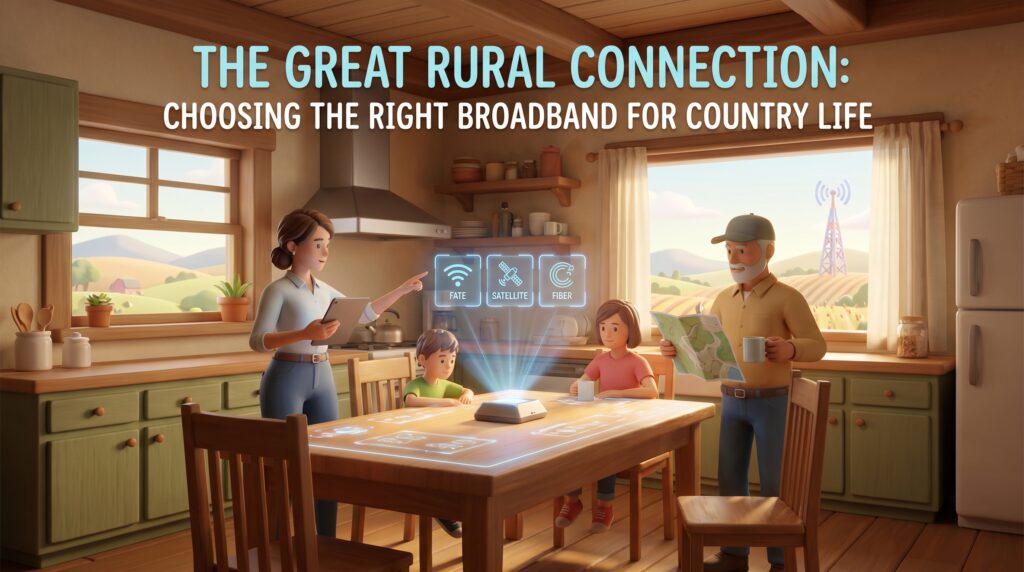
Living in a rural community brings plenty of perks, from the quiet mornings to the sprawling views.
However, it also comes with one big caveat – slower broadband. You quickly realise that the rules for picking an internet connection change the moment you leave the suburbs. In a city, you are often choosing between identical services delivered over the same pipes. Out here, the geography of your home and the materials used to build it play a much bigger role in the speeds you actually receive.
The infrastructure behind the speed
Before looking at the monthly cost or the headline megabits, it is vital to understand the technology delivering the signal. For many years, rural areas relied on Fibre to the Cabinet (FTTC). This system brings a high-speed line to a green box in the nearest village, but then uses the old copper telephone network to reach your front door. The issue is that copper is a fragile material for data. The further your house sits from that cabinet, the more the speed drops away. If you are at the end of a long lane, a package that promises superfast speeds might only deliver a fraction of that by the time it reaches your router.
This is why many people are now looking for Full Fibre broadband, also known as Fibre to the Property (FTTP). This method replaces the copper entirely with a glass cable that runs directly into your home. Because light travels through glass without losing strength over distance, you get the exact speed you pay for, whether you live next to the exchange or out in the wilds. In some specific cases where digging a trench is not an option due to the landscape, fixed wireless is a reliable alternative. This uses a small receiver on your roof to pick up a signal from a local mast, bypassing the need for physical cables altogether.
Identifying the right speed tier for your home
When you browse different broadband packages, the numbers can feel a bit abstract. To choose correctly, you need to consider how many people live in your house and what they do online at the same time.
For a smaller household where the internet is mainly used for checking email, scrolling through news, or watching a movie on a single screen, a 50 Mbps connection is usually the perfect starting point. It provides enough capacity for the basics without paying for bandwidth that stays idle. This speed handles high-definition streaming comfortably and ensures that software updates for your phone or tablet do not take all night.
Once you have a family under one roof, the demand changes. Between teenagers downloading large game files, parents joining video calls, and multiple TVs streaming in 4K, a basic connection will start to feel the strain. For a modern, connected home, the sweet spot is usually between 100Mbps and 300Mbps. This range offers enough “lanes” on your digital motorway so that nobody experiences buffering or lag, even during the busy evening hours when everyone is online at once.

For the heavy users or those who want to forget about speed limits entirely, the gigabit tier of 900Mbps and above is the ultimate choice.
This is for the households of the future. It allows for near-instant downloads of massive files and ensures that your connection is ready for whatever new technology comes along in the next few years.
The importance of upload speeds
Most of the big numbers you see on comparison sites refer to download speed, which is how fast you can pull information from the web. However, if you work from home or run a small business from a rural base, the upload speed is just as important. Uploading is what happens when you send an email with a large attachment, back up your photos to the cloud, or share your video feed during a meeting.
Traditional copper-based connections often have very slow upload speeds. This can lead to grainy video calls or frustrating waits when sending work to a client. When comparing packages, look for those that offer high upload speeds or, ideally, symmetrical speeds where the upload is just as fast as the download. This ensures your professional life runs just as smoothly as your entertainment.
Overcoming the Wi-Fi barrier
Rural homes are often built to last, with thick stone walls, flint, or cob. While these materials are beautiful and keep the house cool, they are the natural enemy of a Wi-Fi signal. A high-speed connection entering your house at the front door is only half the battle. If that signal cannot get through a two-foot-thick wall to reach your bedroom or home office, you will experience dropouts and slow speeds regardless of your package.
This is where Mesh systems like Wessex Internet’s Total WiFi become essential. Instead of relying on a single router to do all the work, a Mesh system uses nodes placed around the property. These nodes work together to create a seamless blanket of coverage. As you move from the kitchen to the study, your device automatically switches to the strongest node. If you have outbuildings like a workshop or a garden office, you should look for options that allow you to extend this network across a yard or garden.
When to consider a leased line
For most residential needs, a standard full-fibre package is more than enough. However, some rural businesses require a level of certainty that goes beyond a standard contract. This is where a Leased Line comes into play. A Leased Line is a private, dedicated data connection between your premises and the internet exchange.
Unlike standard broadband, you are not sharing your bandwidth with your neighbours. During peak times, your speed remains exactly what you pay for without any fluctuation. These connections also come with much more robust service guarantees.
If a problem occurs, a Leased Line contract usually includes a commitment to have you back online within a few hours.
For businesses where a lost connection means a total loss of earnings, this level of reliability is a sensible investment.
Reliability and the local factor
In the countryside, the environment can be tough on infrastructure. High winds, falling branches, and winter storms can all impact your connection. This is why the physical build of the network matters. Underground fibre is significantly more reliable than overhead wires because it is shielded from the elements.
You should also consider the quality of support you will receive. Large national providers often struggle with rural addresses and may not understand the specific challenges of your location. Choosing a provider that understands rural geography often leads to a much better experience if you ever need an engineer to visit. Having someone who knows the local lanes and landmarks can save a lot of time and frustration.
Future-proofing your choice
Our reliance on the internet is only increasing. From smart security cameras and heating systems to agricultural technology in the barn, more devices are joining our networks every day. When you choose a package, think about what your needs might look like in three or five years.
Selecting full fibre broadband means you are building on a solid foundation. If your needs grow, your provider can usually increase your speed with a simple software change rather than needing to dig up your garden again. By considering the infrastructure, the specific needs of your household, and the physical layout of your home, you can find a broadband package that makes rural living as connected as life in any city.
The goal is a connection that just works, allowing you to enjoy the best of the countryside while staying firmly plugged into the digital world. By using a site like ours to weigh up these different factors, you can make an informed decision that suits your property and your lifestyle perfectly.



